Voltron says: so the fed's plan for sopping up all the money they've injected into the system before it causes all kinds of inflation is to offer the banks term deposits of up to one year. Basically selling CDs to the banks so they can earn interest. They have also pledged to keep short term interest rates low, so the banks can borrow money from the fed - basically for free - then give it back to the fed and earn interest. Well, that's one way to keep the banks profitable. The fed issuing debt puts them in direct competition with the Treasury which would raise interest rates. Unless of course, the fed continues to buy treasuries themselves. At the end of a year, the term deposits are returned to the bank (plus interest) so how exactly does this remove the money from the system? It comes back . . . plus interest. So they're just kicking the can down the road (again).
So to recap: The fed is going to lend money overnight at zero interest to banks that will use it to buy one year term deposits from the fed, who will use the money to purchase treasuries from the government to fund the deficit and push long term interest rates low. follow? make sense? no? good. That's because it doesn't make sense. The inmates are running the asylum.
http://www.cnbc.com/id/34616046
Thursday, December 31, 2009
Monday, December 28, 2009
Shorting the Economic Recovery
Excerpt:
PERHAPS ONE OF THE greatest failings in the run-up to the financial meltdown was a lack of perspective -- an inability by many market participants to see the big picture. Not so with Kevin Duffy and Bill Laggner, principals of the Dallas-based hedge fund Bearing Asset Management. With the help of their proprietary credit-bubble index, developed in 2004, the managers sounded early warnings on housing and credit excesses, and capitalized handsomely on their forecasts by shorting Fannie Mae, Freddie Mac, money-center banks and brokers, builders, mortgage insurers and the like.
Students of the Austrian school of economics, which espouses a free-market philosophy that ascribes business-cycle booms and busts to government meddling with interest rates, the pair is solidly in the contrarian camp, believing that the worst for the markets may be yet to come.
The two established Bearing in June 2002 after running their own money and, before that, a stint by Duffy at Lighthouse Capital Management and by Laggner at Fidelity. Bearing now has about $60 million under management, and they have returned on average an impressive 18.28% annually since setting up shop. They hold refreshingly against-the-grain views on what's ahead.
Voltron says: They are short Goldman Sachs, the S&P500 and US and Japanese bonds and long Gold, consumer staples, discount retailers and pharmaceuticals (GRX and WMT)
http://us.rd.yahoo.com/finance/external/barrons/SIG=11vh3n8h5/*http%3A//online.barrons.com/article/SB126167812677704659.html?ru=yahoo&mod=yahoobarrons
PERHAPS ONE OF THE greatest failings in the run-up to the financial meltdown was a lack of perspective -- an inability by many market participants to see the big picture. Not so with Kevin Duffy and Bill Laggner, principals of the Dallas-based hedge fund Bearing Asset Management. With the help of their proprietary credit-bubble index, developed in 2004, the managers sounded early warnings on housing and credit excesses, and capitalized handsomely on their forecasts by shorting Fannie Mae, Freddie Mac, money-center banks and brokers, builders, mortgage insurers and the like.
Students of the Austrian school of economics, which espouses a free-market philosophy that ascribes business-cycle booms and busts to government meddling with interest rates, the pair is solidly in the contrarian camp, believing that the worst for the markets may be yet to come.
The two established Bearing in June 2002 after running their own money and, before that, a stint by Duffy at Lighthouse Capital Management and by Laggner at Fidelity. Bearing now has about $60 million under management, and they have returned on average an impressive 18.28% annually since setting up shop. They hold refreshingly against-the-grain views on what's ahead.
Voltron says: They are short Goldman Sachs, the S&P500 and US and Japanese bonds and long Gold, consumer staples, discount retailers and pharmaceuticals (GRX and WMT)
http://us.rd.yahoo.com/finance/external/barrons/SIG=11vh3n8h5/*http%3A//online.barrons.com/article/SB126167812677704659.html?ru=yahoo&mod=yahoobarrons
Sunday, December 27, 2009
Morgan Stanley: Interest Rates Set To Soar 40% As Bond Vigilantes Make Geithner And Obama Pay For Their Mess
Excerpt:
If Morgan Stanley is right, the best sale of U.S. Treasuries for 2010 may be the short sale.
Yields on benchmark 10-year notes will climb about 40 percent to 5.5 percent, the biggest annual increase since 1999, according to David Greenlaw, chief fixed-income economist at Morgan Stanley in New York. The surge will push interest rates on 30-year fixed mortgages to 7.5 percent to 8 percent, almost the highest in a decade
http://www.bloomberg.com/apps/news?pid=20601087&sid=aiGQrHp46pc4&pos=2
Hat tip to clusterstock.com
If Morgan Stanley is right, the best sale of U.S. Treasuries for 2010 may be the short sale.
Yields on benchmark 10-year notes will climb about 40 percent to 5.5 percent, the biggest annual increase since 1999, according to David Greenlaw, chief fixed-income economist at Morgan Stanley in New York. The surge will push interest rates on 30-year fixed mortgages to 7.5 percent to 8 percent, almost the highest in a decade
http://www.bloomberg.com/apps/news?pid=20601087&sid=aiGQrHp46pc4&pos=2
Hat tip to clusterstock.com
Saturday, December 26, 2009
Friday, December 25, 2009
Fannie and Freddie even worse
Voltron says: The government is removing all limits on bailouts to Fannie Mae and Freddie Mac and pays six million in hush money to the CEOs.
http://finance.yahoo.com/news/Treasury-uncaps-credit-line-rb-3614762079.html?x=0&.v=3
http://www.bloomberg.com/apps/news?pid=20601087&sid=ad2b8bETXV8s&pos=6
http://finance.yahoo.com/news/Treasury-uncaps-credit-line-rb-3614762079.html?x=0&.v=3
http://www.bloomberg.com/apps/news?pid=20601087&sid=ad2b8bETXV8s&pos=6
Thursday, December 24, 2009
Goldman, Deutsche, and the Destructive Use of Synthetic CDOs Come Into Focus
Voltron says: A Collateralized Debt Obligation (CDO) is a bundle of mortgages that is sliced up and sold. The problem was that demand for CDOs exceeded the number of mortgages, after all, the "boom" in home ownership was only a few percentage points. In order to satisfy demand without having to go through the trouble of actually selling real mortgages, dealers created a derivative called "synthetic CDOs" where the cashflows of a CDO were mimiced by using Credit Default Swaps. The problem is that the sellers of the Credit Default Swaps were often the dealers themselves, so they would benefit from mortgages going bad. Yves Smith at Calculated Risk spins a more sinister plot, claiming that Synthetic CDOs were created specifically by dealers to short the housing market. She weaves together a New York Times article and the book "The Greatest Trade"
The point is just how gigantic this fraudulent derivatives house of cards has become.
http://www.nakedcapitalism.com/2009/12/goldman-deutsche-and-the-destructive-use-of-synthetic-cdos-comes-into-focus.html
The point is just how gigantic this fraudulent derivatives house of cards has become.
http://www.nakedcapitalism.com/2009/12/goldman-deutsche-and-the-destructive-use-of-synthetic-cdos-comes-into-focus.html
Wednesday, December 23, 2009
Wells Fargo repays government bailout
Voltron says: Just in time to pay themselves big bonuses.
http://finance.yahoo.com/news/Wells-Fargo-repays-government-rb-4254656597.html?x=0&.v=1
The Modern Dark Ages
If our economy ever truly collapses the consequences will make fifth-century Britain seem like a picnic.
http://www.ft.com/cms/s/0/4b44d88e-ef39-11de-86c4-00144feab49a.html
http://www.ft.com/cms/s/0/4b44d88e-ef39-11de-86c4-00144feab49a.html
Top hedge funds bet on big rise in yields
Excert;
The recent rise in long-term US interest rates comes as good news for several leading hedge fund managers, including John Paulson, who have positioned their trading books to benefit from higher yields on US Treasury securities.
Mr Paulson, who made big gains earlier this decade by betting against the subprime mortgage market and whose firm, Paulson & Co, manages $33bn, has said he believes that government stimulus efforts would inevitably lead to higher inflation and a corresponding rise in rates.
Bond prices fall as yields rise, and Mr Paulson told the Financial Times last week that he has been hoping to benefit in the Treasury market by buying options that would become profitable if rates headed higher. TPG-Axon's Dinakar Singh has been making similar options trades, according to a person familiar with the matter."It will be difficult for the government to withdraw the economic stimulus," Mr Paulson said in a speech. "An increase in the monetary base leads to an increase in the money supply, which leads to inflation."
"Conservative" college savings plan lost 38%
Voltron says: This is why you should do the pre-paid tuition plan and not the 529 college savings plan.
http://www.chicagotribune.com/news/chi-wed-bright-start-dec23,0,7275727.story
Tuesday, December 22, 2009
Mint reveals how it lost a fortune in gold
Voltron says: maybe now they will be able to finish their "system upgrades" and begin opening new gold storage accounts through kitco.
Excerpt:
OTTAWA — More than $3 million in government gold was unwittingly sold off at a fraction of its value as refinery slag, while $8 million more was miscounted and never left the Royal Canadian Mint, the Crown corporation revealed Monday in a full accounting of how it lost track of a fortune in gold for a year.
A series of miscalculations and blunders in the mint's gold refinery dating back to 2005 were responsible for 17,500 troy ounces — a system of weights for precious metals — of gold going missing from the mint's Ottawa inventory count last October, the mint announced in a 12-page report.
That's the equivalent of almost 44,400-ounce bars, worth more than $20 million in today's prices.
Sunday, December 20, 2009
Wednesday, December 16, 2009

Target-Date Mutual Funds Take Huge Risks In Junk Bonds
Voltron says: Target Date mutual funds (such as TSP "L" funds) are an easy way to automatically carry out conventional investing practices with your money. They move money over time from what is considered a risky investment (stocks) into what is considered more stable (bonds) as you approach the target date when presumably you will need the money. This doesn't work well if the bonds they choose are risky (junk bonds). Apparently some of these funds are charging quite high fees for funds that really is not much more difficult to manage than an index fund.
http://globaleconomicanalysis.blogspot.com/2009/12/target-date-lifestyle-retirement-funds.html
http://globaleconomicanalysis.blogspot.com/2009/12/target-date-lifestyle-retirement-funds.html

Tuesday, December 15, 2009
Wells Fargo is repaying the government bailout
"Wells is not making money on an operating basis," said Paul Miller, managing director over at FBR Capital Markets (Underperform). "Most of their gains are from trading, and if rates ever go up, they could be in a precarious position."
http://www.cnbc.com/id/34435902/site/14081545
http://www.cnbc.com/id/34435902/site/14081545
'Substantial’ Bank Losses Are Needed to Fix Housing
Voltron says: Only principal reductions will stem foreclosure, but banks are unwilling because that would wipe out any second mortgages, such as home equity loans. Banks currently have $855 billion in home equity loans at risk.
http://www.bloomberg.com/apps/news?pid=20601087&sid=a6D57m4TPGvs&pos=6
http://www.bloomberg.com/apps/news?pid=20601087&sid=a6D57m4TPGvs&pos=6
Monday, December 14, 2009
Morgan Stanley’s Roach Sees ‘Great Risk’ in Fed Exit Strategy
Dec. 12 (Bloomberg) -- The Federal Reserve may cause another crisis by botching the withdrawal of liquidity from the U.S. economy, Morgan Stanley Asia Chairman Stephen Roach said.
The Fed is the "weak link" among central banks and may fail to tighten monetary policy in time to stop asset bubbles from forming, Roach said at a conference in Berlin today. The Fed helped trigger the boom and then bust of the subprime mortgage market by being "quick to slash, slow to normalize" interest rates, he said.
http://www.bloomberg.com/apps/news?pid=20601087&sid=aVnNCyH.q1no&pos=7
The Fed is the "weak link" among central banks and may fail to tighten monetary policy in time to stop asset bubbles from forming, Roach said at a conference in Berlin today. The Fed helped trigger the boom and then bust of the subprime mortgage market by being "quick to slash, slow to normalize" interest rates, he said.
http://www.bloomberg.com/apps/news?pid=20601087&sid=aVnNCyH.q1no&pos=7
Greenspan: Bernanke Is Out Of Bullets, Now Inflation Is The Big Risk
Reuters: The U.S. Federal Reserve has done all it can do to reduce unemployment and needs to worry more about the risk of inflation from the stimulus it poured into the economy, former Fed Chairman Alan Greenspan said on Sunday.
"I think the Fed has done an extraordinary job and it's done a huge amount (to bolster employment). There's just so much monetary policy and the central bank can do. And I think they've gone to their limits, at this particular stage," Greenspan said on NBC's "Meet the Press."
http://www.businessinsider.com/greenspan-bernanke-is-out-of-bullets-here-comes-inflation-2009-12
"I think the Fed has done an extraordinary job and it's done a huge amount (to bolster employment). There's just so much monetary policy and the central bank can do. And I think they've gone to their limits, at this particular stage," Greenspan said on NBC's "Meet the Press."
http://www.businessinsider.com/greenspan-bernanke-is-out-of-bullets-here-comes-inflation-2009-12
Sunday, December 13, 2009
Drug money saved the banks
Voltron says: more evidence that the economy is completely dominated by fraud and criminal activity.
From the U.K. Guardian:
http://www.guardian.co.uk/global/2009/dec/13/drug-money-banks-saved-un-cfief-claims
From the U.K. Guardian:
Drugs money worth billions of dollars kept the financial system afloat at the height of the global crisis, the United Nations' drugs and crime tsar has told the Observer.
Antonio Maria Costa, head of the UN Office on Drugs and Crime, said he has seen evidence that the proceeds of organised crime were "the only liquid investment capital" available to some banks on the brink of collapse last year. He said that a majority of the $352bn (£216bn) of drugs profits was absorbed into the economic system as a result.
This will raise questions about crime's influence on the economic system at times of crisis.
http://www.guardian.co.uk/global/2009/dec/13/drug-money-banks-saved-un-cfief-claims
Saturday, December 12, 2009
Matt Taibbi: Obama's Big Sellout
Voltron says: I don't normally get into politics on this board, but I think it's important to understand that no effective reforms will be passed and the government intends to paper over the losses for as many election cycles as our foreign creditors allow. Matt Taibbi at Rolling Stone wrote an accurate article about this in his refreshingly vulgar style. First he explains how immediately after the election, Obama appointed to high office, the very people who caused the financial problems. He then goes on to explain the current state of legislation:
Voltron says: I think that Obama appointed people he knew from his 12 years as a law professor at University of Chicago where an "efficient market" religion developed, so radical that devotees believed that fraud did not have to be regulated because an efficient market would automatically weed it out without any intervention. This is laughable. Also, I think many people assume that since Republicans support free-markets, that most Wall Street tycoons are Republican when in fact they are almost all "Limousine Democrats" and the Democratic party is enamored with anyone who is somehow able to become rich, because they need money to win elections and most of them cannot fathom how to make money themselves.
Full article: http://www.rollingstone.com/politics/story/31234647/obamas_big_sellout/print
But the real kicker came when Frank's committee took up what is known as "resolution authority" — government-speak for "Who the hell is in charge the next time somebody at AIG or Lehman Brothers decides to vaporize the economy?" What the committee initially introduced bore a striking resemblance to a proposal written by Geithner earlier in the summer. A masterpiece of legislative chicanery, the measure would have given the White House permanent and unlimited authority to execute future bailouts of megaconglomerates like Citigroup and Bear Stearns.
Democrats pushed the move as politically uncontroversial, claiming that the bill will force Wall Street to pay for any future bailouts and "doesn't use taxpayer money." In reality, that was complete bullshit. The way the bill was written, the FDIC would basically borrow money from the Treasury — i.e., from ordinary taxpayers — to bail out any of the nation's two dozen or so largest financial companies that the president deems in need of government assistance. After the bailout is executed, the president would then levy a tax on financial firms with assets of more than $10 billion to repay the Treasury within 60 months — unless, that is, the president decides he doesn't want to! "They can wait indefinitely to repay," says Rep. Brad Sherman of California, who dubbed the early version of the bill "TARP on steroids."
The new bailout authority also mandated that future bailouts would not include an exchange of equity "in any form" — meaning that taxpayers would get nothing in return for underwriting Wall Street's mistakes. Even more outrageous, it specifically prohibited Congress from rejecting tax giveaways to Wall Street, as it did last year, by removing all congressional oversight of future bailouts. In fact, the resolution authority proposed by Frank was such a slurpingly obvious blow job of Wall Street that it provoked a revolt among his own committee members, with junior Democrats waging a spirited fight that restored congressional oversight to future bailouts, requires equity for taxpayer money and caps assistance to troubled firms at $150 billion. Another amendment to force companies with more than $50 billion in assets to pay into a rainy-day fund for bailouts passed by a resounding vote of 52 to 17 — with the "Nays" all coming from Frank and other senior Democrats loyal to the administration.
Even as amended, however, resolution authority still has the potential to be truly revolutionary legislation. The Senate version still grants the president unlimited power over equity-free bailouts, and the amended House bill still institutionalizes a system of taxpayer support for the 20 to 25 biggest banks in the country. It would essentially grant economic immortality to those top few megafirms, who will continually gobble up greater and greater slices of market share as money becomes cheaper and cheaper for them to borrow (after all, who wouldn't lend to a company permanently backstopped by the federal government?). It would also formalize the government's role in the global economy and turn the presidential-appointment process into an important part of every big firm's business strategy. "If this passes, the very first thing these companies are going to do in the future is ask themselves, 'How do we make sure that one of our executives becomes assistant Treasury secretary?'" says Sherman.
Voltron says: I think that Obama appointed people he knew from his 12 years as a law professor at University of Chicago where an "efficient market" religion developed, so radical that devotees believed that fraud did not have to be regulated because an efficient market would automatically weed it out without any intervention. This is laughable. Also, I think many people assume that since Republicans support free-markets, that most Wall Street tycoons are Republican when in fact they are almost all "Limousine Democrats" and the Democratic party is enamored with anyone who is somehow able to become rich, because they need money to win elections and most of them cannot fathom how to make money themselves.
Full article: http://www.rollingstone.com/politics/story/31234647/obamas_big_sellout/print
Thursday, December 10, 2009
Wednesday, December 9, 2009
Colbert on the Federal Reserve (video)
Part I
Part II with Sen Bernie Sanders (he's a Socialist, but some funny parts)
| The Colbert Report | Mon - Thurs 11:30pm / 10:30c | |||
| Fed's Dead | ||||
| ||||
Part II with Sen Bernie Sanders (he's a Socialist, but some funny parts)
| The Colbert Report | Mon - Thurs 11:30pm / 10:30c | |||
| Fed's Dead - Bernie Sanders | ||||
| ||||
Tuesday, December 8, 2009
Moody's: USofA leads the way out of AAA
Excerpt:
Moody’s, meanwhile, indicates that a number of sovereign borrowers are moving out of AAA territory by the simple measure of interest payments as a percentage of GDP:

Under US government projections, debt service will exceed 10% of GDP by 2013, which means that by one measure the US will move out of AAA territory. But the UK, Germany and France will be headed in the same direction.
If I am correct that economic weakness continues unabated through the next couple of years, the situation will be considerable worse than the Moody’s graph suggests, and governments will have difficulty funding themselves at today’s extremely low interest rates.
http://blog.atimes.net/?p=1262
Moody’s, meanwhile, indicates that a number of sovereign borrowers are moving out of AAA territory by the simple measure of interest payments as a percentage of GDP:
Under US government projections, debt service will exceed 10% of GDP by 2013, which means that by one measure the US will move out of AAA territory. But the UK, Germany and France will be headed in the same direction.
If I am correct that economic weakness continues unabated through the next couple of years, the situation will be considerable worse than the Moody’s graph suggests, and governments will have difficulty funding themselves at today’s extremely low interest rates.
http://blog.atimes.net/?p=1262
Sunday, December 6, 2009
Geithner: “none…would have survived”
Excerpt:
Secretary Geithner acknowledges what most doomsdayers were saying last fall, that without the government’s extraordinary rescue measures, the entire financial system was on the verge of collapse. (Miller/Harper, Bloomberg)
Some have said this recent financial crisis wasn’t as bad as the 1930s’. I disagree, and have posted the following chart to make the point.

Voltron says: Of course, the Feds didn't actually fix anything so the collapse is still coming.
http://blogs.reuters.com/rolfe-winkler/2009/12/06/geithner-none-would-have-survived/
Secretary Geithner acknowledges what most doomsdayers were saying last fall, that without the government’s extraordinary rescue measures, the entire financial system was on the verge of collapse. (Miller/Harper, Bloomberg)
“None of [the big Wall Street insitutions] would have survived” had the government stood aside and let the crisis run its course, he said. “The entire U.S. financial system and all the major firms in the country, and even small banks across the country, were at that moment at the middle of a classic run, a classic bank run.”
Some have said this recent financial crisis wasn’t as bad as the 1930s’. I disagree, and have posted the following chart to make the point.
Voltron says: Of course, the Feds didn't actually fix anything so the collapse is still coming.
http://blogs.reuters.com/rolfe-winkler/2009/12/06/geithner-none-would-have-survived/
Saturday, December 5, 2009
Why Many Home Loan Modifications Fail
Voltron says: to get a permanent mod, you must prove yout income so all the people with "liar" (i.e. stated income) loans won't qualify. The applicant's income and appraised house value must be "goldilocks" (not too low, not too high).
http://www.nytimes.com/2009/12/04/business/economy/04norris.html
Wednesday, December 2, 2009
Credit Default Swaps will be exchage traded
Voltron says: this is supposed to prevent another AIG situation because the exhange will require collateral to be settled daily. My first thought was "wow, I can buy Credit default swaps on wells fargo now". I'm sure they will make the contract size large to discourage Joe six-pack from buying them, but it's sure to cause CDS volumes to rise. If there are no contract limits, nothing stops the people from buying up more CDS than the company is worth, then blowing up the company.
Tuesday, December 1, 2009
Wells Fargo will go bust
Voltron: This article suggests that Wachovia will bring down Wells
Fargo, but their home equity loans exposure is at least twice as
large, so they were screwed anyway.
Fargo, but their home equity loans exposure is at least twice as
large, so they were screwed anyway.
Monday, November 30, 2009
How Economic Weakness Endangers the U.S.
Harvard prof Niall Ferguson predicts higher real interest rates and decreased US military spending.
China, gold, and the civilization shift
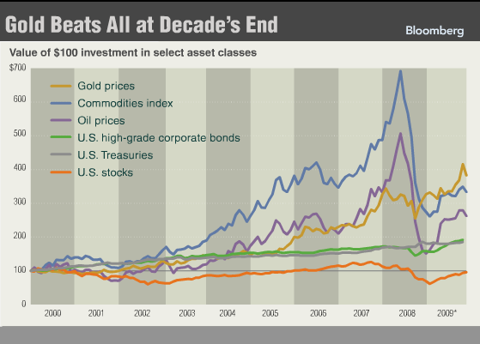
Mr Jen is an expert on sovereign wealth funds from his days at Morgan Stanley. The gold story — essentially — is that the rising economic powers of Asia, the Middle East, and the commodity bloc are rejecting Western fiat currencies. China, India, and Russia have all been buying gold on a large scale over recent months.
http://blogs.telegraph.co.uk/finance/ambroseevans-pritchard/100002252/china-gold-and-the-civilization-shift/
http://blogs.telegraph.co.uk/finance/ambroseevans-pritchard/100002252/china-gold-and-the-civilization-shift/
Tuesday, November 24, 2009

High End Housing is Weak
Voltron says: high priced houses are not being supported or subsidized by FHA, VA, Fannie, Freddie, Ginnie, First Time Home Buyer Tax Credit, etc., so that is where weakness is showing.

http://www.voiceofsandiego.org/articles/2009/11/25/toscano/660highendhousingweakness112409.txt
http://www.voiceofsandiego.org/articles/2009/11/25/toscano/660highendhousingweakness112409.txt
Short sellers are returning
Excerpt: Short interest on the New York Stock Exchange and Nasdaq edged
higher in early November, data from the exchanges showed on Tuesday,
signaling that some investors are betting the equity run-up might hit some
turbulence as 2009 winds down.
higher in early November, data from the exchanges showed on Tuesday,
signaling that some investors are betting the equity run-up might hit some
turbulence as 2009 winds down.
Voltron says: Fortunately, I got out of all my short positions in March
(http://cfcsux.blogspot.com/2009/03/im-out-of-srs.html). I started
re-shorting Wells Fargo at an average price of $20. (It's $27 now . . .
Ouch) If you're looking for something to short . . . I recommend Wells
Fargo. They are bankrupt 3-4 times over by my estimate.
http://www.reuters.com/article/marketsNews/idCNN2421092420091124
House Party
Voltron says: how come I never get invited to parties like this?
Excerpt:
Sunday, November 22, 2009
Wave of Debt Payments Facing U.S. Government
Voltron: Treasury officials estimate that about 36 percent of the government’s marketable debt — about $1.6 trillion — is coming due in the months ahead.
http://www.nytimes.com/2009/11/23/business/23rates.html
http://www.nytimes.com/2009/11/23/business/23rates.html
Wednesday, November 18, 2009
Housing Recession - Double Dip?
Four factors:
- Tax Incentive Ending
- Increasing Loan Difficulty
- Unemployment
- Built Up Supply
Monday, November 16, 2009
Peter Schiff in top form (video)
Voltron says: You know it's time to short when they are openly mocking Peter Schiff on CNBC
Meredith Whitney is bearish (video)
Financials are taking a hit after Meredith Whitney told CNBC that she "hasn't been this bearish in a year."
She's also calling for a "double dip" recession.
StreetInsider bullet-points her comments:
She's also calling for a "double dip" recession.
StreetInsider bullet-points her comments:
- the banking sector is "not adequately capitalized today"
- sees another leg down in the residential real estate market when mortgage rates/prices begin moving lower. To this point, Meredith said she feels that there is still a much bigger risk related to residential mortgage exposure, rather than commercial.
- says that this market makes "no sense" to her and that there is no fundamentals behind the recent rally in stocks
- within the banking sector the major difference between the market today and last year is that there is no mark-to-market now.
- "banks will go back to tangible book value"
- sell the banks
- would sit on cash until another leg down in valuation, estimates
- "everything's expensive right now"
- expecting a double dip recession, although the second part of "W" will not be as severe
Sunday, November 15, 2009
Goldman Sachs is short Wells Fargo
Voltron says: Wells Fargo is Goldman's second largest short position at -$290 million.
Saturday, November 14, 2009
Off Topic: War and Auctions
Paying a Price for the Thrill of the Hunt
By RICHARD H. THALER, The New York Times
Excerpt:
IF a business school professor is running short on cash, there is a sure-fire solution: run a dollar auction game in class.
To start, the professor offers to sell the class a $20 bill. Bidding starts at $1 and goes up in $1 increments. The winner pays the professor whatever the high bid was, and gets the $20. Here’s the catch: the second-highest bidder also has to pay, but gets nothing in return.
Typically, a few brave or stupid students — nearly always male — open the bidding but fairly quickly only two bidders remain and they discover they are in a war of attrition. The bidding slows when someone bids $20, but then resumes with neither wanting to “lose.” If the two students are particularly stubborn, prices can go over $50. (The professor typically gives the money to charity, or claims to.)
The dollar auction game was invented by a pioneer of game theory, Martin Shubik of Yale, and it illustrates the concept of “escalation of commitment.” Once people are trapped into playing, they have a hard time stopping. (Consider Vietnam.) The higher the bidding goes, and the more each bidder has invested, the harder it is to say “uncle.” The best advice you can give anyone invited to play this particular game is to decline.
...
[Swoopo.com] sells new merchandise using unusual auction formats. Let’s concentrate on one of them, the so-called penny auction.
Typically an item — say, a laptop that retails for $1,500, is offered for sale. The bidding starts at a penny, and goes up in one-cent increments, but it costs bidders 60 cents to make a bid. Each auction has a scheduled closing time, but as the deadline nears, that time is extended by 20 seconds whenever someone bids.
The site’s home page displays several attractive objects for sale with closing times fast approaching. It is mesmerizing.
...
What makes this procedure so devilish is that while bidders are looking at what seem to be amazing bargains, the Web site is raking in the money. Because Swoopo collects 60 cents for each penny bid, its revenue is the selling price multiplied by 60. This means that if a computer you covet sells for $100, seemingly a bargain, Swoopo collects $6,000 in revenue, a very juicy profit.
By RICHARD H. THALER, The New York Times
Excerpt:
IF a business school professor is running short on cash, there is a sure-fire solution: run a dollar auction game in class.
To start, the professor offers to sell the class a $20 bill. Bidding starts at $1 and goes up in $1 increments. The winner pays the professor whatever the high bid was, and gets the $20. Here’s the catch: the second-highest bidder also has to pay, but gets nothing in return.
Typically, a few brave or stupid students — nearly always male — open the bidding but fairly quickly only two bidders remain and they discover they are in a war of attrition. The bidding slows when someone bids $20, but then resumes with neither wanting to “lose.” If the two students are particularly stubborn, prices can go over $50. (The professor typically gives the money to charity, or claims to.)
The dollar auction game was invented by a pioneer of game theory, Martin Shubik of Yale, and it illustrates the concept of “escalation of commitment.” Once people are trapped into playing, they have a hard time stopping. (Consider Vietnam.) The higher the bidding goes, and the more each bidder has invested, the harder it is to say “uncle.” The best advice you can give anyone invited to play this particular game is to decline.
...
[Swoopo.com] sells new merchandise using unusual auction formats. Let’s concentrate on one of them, the so-called penny auction.
Typically an item — say, a laptop that retails for $1,500, is offered for sale. The bidding starts at a penny, and goes up in one-cent increments, but it costs bidders 60 cents to make a bid. Each auction has a scheduled closing time, but as the deadline nears, that time is extended by 20 seconds whenever someone bids.
The site’s home page displays several attractive objects for sale with closing times fast approaching. It is mesmerizing.
...
What makes this procedure so devilish is that while bidders are looking at what seem to be amazing bargains, the Web site is raking in the money. Because Swoopo collects 60 cents for each penny bid, its revenue is the selling price multiplied by 60. This means that if a computer you covet sells for $100, seemingly a bargain, Swoopo collects $6,000 in revenue, a very juicy profit.
Wednesday, November 11, 2009
World gold supply running out
By Ambrose Evans-Pritchard, UK Telegraph
Aaron Regent, president of the Canadian gold giant, said that global output has been falling by roughly 1m ounces a year since the start of the decade. Total mine supply has dropped by 10pc as ore quality erodes, implying that the roaring bull market of the last eight years may have further to run.
Ore grades have fallen from around 12 grams per tonne in 1950 to nearer 3 grams in the US, Canada, and Australia. South Africa's output has halved since peaking in 1970.
...
Aaron Regent, president of the Canadian gold giant, said that global output has been falling by roughly 1m ounces a year since the start of the decade. Total mine supply has dropped by 10pc as ore quality erodes, implying that the roaring bull market of the last eight years may have further to run.
"There is a strong case to be made that we are already at 'peak gold'," he told The Daily Telegraph at the RBC's annual gold conference in London.
"Production peaked around 2000 and it has been in decline ever since, and we forecast that decline to continue. It is increasingly difficult to find ore," he said.
Ore grades have fallen from around 12 grams per tonne in 1950 to nearer 3 grams in the US, Canada, and Australia. South Africa's output has halved since peaking in 1970.
...
Mr Norman said the "false mine of central banks" had been the only new source of gold supply this decade as they auction off reserves, but they are switching sides to become net buyers.
[Mining company Barrick Gold] is moving fast to wind down the remaining 3m ounces of its infamous hedge book over the next twelve months, an implicit bet on rising gold prices over time.

Tungsten gold
Excerpt:
In early 2008 it was reported that at least some of the gold bars in the vaults at the National Bank of Ethiopia were fake. The discovery was made when bars shipped from Ethiopia to South Africa were returned after they were identified as being gilded steel.
Gilded steel is a very unconvincing form of fake gold because the density of the iron alloy is significantly less. . . . There are two metals that are suitable, from both a density and economic perspective, for manufacturing fake gold - uranium and tungsten.
A Chinese company called Chinatungsten is advertising imitation gold merchandise on its website. The following quote is taken directly from their Tungsten Alloy for Gold Substitution page:
"a coin with a tungsten center and gold all around it could not be detected as counterfeit by density measurement alone ... We are well accustomed to exploit more innovative applications of tungsten products. Gold-plated tungsten is one of our main products."
http://www.tungsten-alloy.com/en/alloy11.htm
http://www.safehaven.com/article-14990.htm
In early 2008 it was reported that at least some of the gold bars in the vaults at the National Bank of Ethiopia were fake. The discovery was made when bars shipped from Ethiopia to South Africa were returned after they were identified as being gilded steel.
Gilded steel is a very unconvincing form of fake gold because the density of the iron alloy is significantly less. . . . There are two metals that are suitable, from both a density and economic perspective, for manufacturing fake gold - uranium and tungsten.
A Chinese company called Chinatungsten is advertising imitation gold merchandise on its website. The following quote is taken directly from their Tungsten Alloy for Gold Substitution page:
"a coin with a tungsten center and gold all around it could not be detected as counterfeit by density measurement alone ... We are well accustomed to exploit more innovative applications of tungsten products. Gold-plated tungsten is one of our main products."
http://www.tungsten-alloy.com/en/alloy11.htm
http://www.safehaven.com/article-14990.htm
Monday, November 9, 2009
Key oil figures were distorted by US pressure, says whistleblower
Excerpt:
The world is much closer to running out of oil than official estimates admit, according to a whistleblower at the International Energy Agency who claims it has been deliberately underplaying a looming shortage for fear of triggering panic buying.
The senior official claims the US has played an influential role in encouraging the watchdog to underplay the rate of decline from existing oil fields while overplaying the chances of finding new reserves.
The allegations raise serious questions about the accuracy of the organisation's latest World Energy Outlook on oil demand and supply to be published tomorrow – which is used by the British and many other governments to help guide their wider energy and climate change policies.
In particular they question the prediction in the last World Economic Outlook, believed to be repeated again this year, that oil production can be raised from its current level of 83m barrels a day to 105m barrels. External critics have frequently argued that this cannot be substantiated by firm evidence and say the world has already passed its peak in oil production.
Now the "peak oil" theory is gaining support at the heart of the global energy establishment. "The IEA in 2005 was predicting oil supplies could rise as high as 120m barrels a day by 2030 although it was forced to reduce this gradually to 116m and then 105m last year," said the IEA source, who was unwilling to be identified for fear of reprisals inside the industry. "The 120m figure always was nonsense but even today's number is much higher than can be justified and the IEA knows this.
"Many inside the organisation believe that maintaining oil supplies at even 90m to 95m barrels a day would be impossible but there are fears that panic could spread on the financial markets if the figures were brought down further. And the Americans fear the end of oil supremacy because it would threaten their power over access to oil resources," he added.
A second senior IEA source, who has now left but was also unwilling to give his name, said a key rule at the organisation was that it was "imperative not to anger the Americans" but the fact was that there was not as much oil in the world as had been admitted. "We have [already] entered the 'peak oil' zone. I think that the situation is really bad," he added.
...
But as far back as 2004 there have been people making similar warnings. Colin Campbell, a former executive with Total of France told a conference: "If the real [oil reserve] figures were to come out there would be panic on the stock markets … in the end that would suit no one."
http://www.guardian.co.uk/environment/2009/nov/09/peak-oil-international-energy-agency
The world is much closer to running out of oil than official estimates admit, according to a whistleblower at the International Energy Agency who claims it has been deliberately underplaying a looming shortage for fear of triggering panic buying.
The senior official claims the US has played an influential role in encouraging the watchdog to underplay the rate of decline from existing oil fields while overplaying the chances of finding new reserves.
The allegations raise serious questions about the accuracy of the organisation's latest World Energy Outlook on oil demand and supply to be published tomorrow – which is used by the British and many other governments to help guide their wider energy and climate change policies.
In particular they question the prediction in the last World Economic Outlook, believed to be repeated again this year, that oil production can be raised from its current level of 83m barrels a day to 105m barrels. External critics have frequently argued that this cannot be substantiated by firm evidence and say the world has already passed its peak in oil production.
Now the "peak oil" theory is gaining support at the heart of the global energy establishment. "The IEA in 2005 was predicting oil supplies could rise as high as 120m barrels a day by 2030 although it was forced to reduce this gradually to 116m and then 105m last year," said the IEA source, who was unwilling to be identified for fear of reprisals inside the industry. "The 120m figure always was nonsense but even today's number is much higher than can be justified and the IEA knows this.
"Many inside the organisation believe that maintaining oil supplies at even 90m to 95m barrels a day would be impossible but there are fears that panic could spread on the financial markets if the figures were brought down further. And the Americans fear the end of oil supremacy because it would threaten their power over access to oil resources," he added.
A second senior IEA source, who has now left but was also unwilling to give his name, said a key rule at the organisation was that it was "imperative not to anger the Americans" but the fact was that there was not as much oil in the world as had been admitted. "We have [already] entered the 'peak oil' zone. I think that the situation is really bad," he added.
...
But as far back as 2004 there have been people making similar warnings. Colin Campbell, a former executive with Total of France told a conference: "If the real [oil reserve] figures were to come out there would be panic on the stock markets … in the end that would suit no one."
http://www.guardian.co.uk/environment/2009/nov/09/peak-oil-international-energy-agency
Friday, November 6, 2009
Official unemployment at 10.2%, actually 17.5%
Voltron says: The larger number includes "discouraged" workers and people
forced to work part-time. Highest since 1983. The DOW is back above
10,000.
forced to work part-time. Highest since 1983. The DOW is back above
10,000.
http://blogs.wsj.com/economics/2009/11/06/broader-unemployment-rate-hits-175
/
Thursday, November 5, 2009
More on "ruthless default"
Abstract
Despite reports that homeowners are increasingly “walking away” from their mortgages, most homeowners continue to make their payments even when they are significantly underwater. This article suggests that most homeowners choose not to strategically default as a result of two emotional forces: 1) the desire to avoid the shame and guilt of foreclosure; and 2) exaggerated anxiety over foreclosure’s perceived consequences. Moreover, these emotional constraints are actively cultivated by the government and other social control agents in order to encourage homeowners to follow social and moral norms related to the honoring of financial obligations - and to ignore market and legal norms under which strategic default might be both viable and the wisest financial decision. Norms governing homeowner behavior stand in sharp contrast to norms governing lenders, who seek to maximize profits or minimize losses irrespective of concerns of morality or social responsibility. This norm asymmetry leads to distributional inequalities in which individual homeowners shoulder a disproportionate burden from the housing collapse.
http://globaleconomicanalysis.blogspot.com/2009/10/government-and-lender-policies-of-fear.html
Despite reports that homeowners are increasingly “walking away” from their mortgages, most homeowners continue to make their payments even when they are significantly underwater. This article suggests that most homeowners choose not to strategically default as a result of two emotional forces: 1) the desire to avoid the shame and guilt of foreclosure; and 2) exaggerated anxiety over foreclosure’s perceived consequences. Moreover, these emotional constraints are actively cultivated by the government and other social control agents in order to encourage homeowners to follow social and moral norms related to the honoring of financial obligations - and to ignore market and legal norms under which strategic default might be both viable and the wisest financial decision. Norms governing homeowner behavior stand in sharp contrast to norms governing lenders, who seek to maximize profits or minimize losses irrespective of concerns of morality or social responsibility. This norm asymmetry leads to distributional inequalities in which individual homeowners shoulder a disproportionate burden from the housing collapse.
http://globaleconomicanalysis.blogspot.com/2009/10/government-and-lender-policies-of-fear.html
Tuesday, November 3, 2009
Wells Fargo is in denial
Excerpt:
Wells Fargo & Co.'s strategy for modifying troubled Pick-A-Pay mortgages looks like a game of kick-the-can-down-the-road.
The fourth-largest U.S. bank by assets holds about $107 billion in debt tied to option adjustable-rate mortgages, a relic of the U.S. housing boom that allowed borrowers to make small monthly payments in return for increasing their mortgage balance. Many such borrowers now own homes worth far less than they owe in mortgage debt, and most can't afford a full monthly payment that pays down the loan's principal.
To solve that conundrum, Wells Fargo is taking a gamble: The San Francisco company is issuing thousands of interest-only loans that will defer borrowers' balances for as long as six to 10 years.
Wells Fargo is wagering that an eventual rise in housing prices in the worst-hit regions of the U.S. and a rise in consumer income, will eventually cover the bank's underwater Pick-A-Pay debt. "We're banking on the fact the economy will improve and recover over time," Michael Heid, co-president of Wells Fargo Home Mortgage, said in an interview.
The move to shift Pick-A-Pay borrowers into interest-only loans helps Wells Fargo avoid hefty write-downs on Pick-A-Pay mortgages that would likely result from foreclosures. But the strategy will leave Wells Fargo holding billions of dollars in mortgage debt tied to distressed properties in battered markets, especially California and Florida.
link: http://online.wsj.com/article/SB125728972492326499.html?ru=yahoo&mod=yahoo_hs
Wells Fargo & Co.'s strategy for modifying troubled Pick-A-Pay mortgages looks like a game of kick-the-can-down-the-road.
The fourth-largest U.S. bank by assets holds about $107 billion in debt tied to option adjustable-rate mortgages, a relic of the U.S. housing boom that allowed borrowers to make small monthly payments in return for increasing their mortgage balance. Many such borrowers now own homes worth far less than they owe in mortgage debt, and most can't afford a full monthly payment that pays down the loan's principal.
To solve that conundrum, Wells Fargo is taking a gamble: The San Francisco company is issuing thousands of interest-only loans that will defer borrowers' balances for as long as six to 10 years.
Wells Fargo is wagering that an eventual rise in housing prices in the worst-hit regions of the U.S. and a rise in consumer income, will eventually cover the bank's underwater Pick-A-Pay debt. "We're banking on the fact the economy will improve and recover over time," Michael Heid, co-president of Wells Fargo Home Mortgage, said in an interview.
The move to shift Pick-A-Pay borrowers into interest-only loans helps Wells Fargo avoid hefty write-downs on Pick-A-Pay mortgages that would likely result from foreclosures. But the strategy will leave Wells Fargo holding billions of dollars in mortgage debt tied to distressed properties in battered markets, especially California and Florida.
link: http://online.wsj.com/article/SB125728972492326499.html?ru=yahoo&mod=yahoo_hs
Gold surges to new record high
Voltron says: the IMF sold 200 tonnes of gold to India for $6.7 Billion. Normally that much supply would crush the price of gold, but instead the price surged. The reason is because the IMF had already announced that it would sell 400 tonnes of gold so the market already factored that in. The fact the India is buying it as reserves to put in a vault, never to see the light of day means that supply is basically gone rather than flooding the market.
http://www.breitbart.com/article.php?id=CNG.4dadcffd230970c1a66462397286ee1f.381&show_article=1
Saturday, October 31, 2009
Fed Ends Treasury Buys That Capped Rates, Stabilized Housing
Excerpt:
Oct. 29 (Bloomberg) -- The Federal Reserve completed its $300 billion Treasury purchase program today amid signs the seven-month buying spree helped stabilize the housing market and limited increases in borrowing costs.
Yields on the benchmark 10-year note, which help determine rates on everything from mortgages to corporate bonds, never rose above 4 percent after the central bank began acquiring the debt. They are less than half a percentage point higher than the day before the program was announced on March 18, even though the U.S. sold a record $1.25 trillion in notes and bonds, more than double the amount in the year-earlier period.
http://www.bloomberg.com/apps/news?pid=20601087&sid=aogAIdJC8sRc
Oct. 29 (Bloomberg) -- The Federal Reserve completed its $300 billion Treasury purchase program today amid signs the seven-month buying spree helped stabilize the housing market and limited increases in borrowing costs.
Yields on the benchmark 10-year note, which help determine rates on everything from mortgages to corporate bonds, never rose above 4 percent after the central bank began acquiring the debt. They are less than half a percentage point higher than the day before the program was announced on March 18, even though the U.S. sold a record $1.25 trillion in notes and bonds, more than double the amount in the year-earlier period.
http://www.bloomberg.com/apps/news?pid=20601087&sid=aogAIdJC8sRc
Thursday, October 29, 2009
A Sham GDP for a Sham Economy
Voltron says: Government spending goes straight to GDP even though it's adding to the debt.
http://blogs.wsj.com/deals/2009/10/29/mean-street-a-sham-gdp-for-a-sham-economy/?mod=yahoo_hs
Tuesday, October 27, 2009
Gold Frauds
GLD, a leading gold ETF, which publishes its bar-list every Friday at the close of business, reporting the serial number of every bar in inventory. The list is customarily well over a thousand pages long. But, lo and behold, on Friday, October 2, and on Friday, October 9, the bar-list shrank to a mere couple hundred pages, with no explanation offered.
Reports are circulating that similar audits of certain Asian depositorieshave already produced "good" delivery bars (400 oz or 12.5 kg gold bricks) that have been gutted and stuffed with tungsten - a metal whose specific weight approximates that of gold
http://www.businessinsider.com/mystery-why-did-glds-published-list-of-gold-bars-shrink-2009-10
Monday, October 26, 2009
Even The U.S. Treasury Is Betting On Higher Inflation
Voltron says: The U.S. Treasury is planning to issue more long-term debt, which will lower 30-year bond prices.
http://www.businessinsider.com/us-effort-to-issue-higher-mix-of-long-term-bonds-says-they-know-rates-are-too-low-2009-10
http://www.businessinsider.com/us-effort-to-issue-higher-mix-of-long-term-bonds-says-they-know-rates-are-too-low-2009-10
Sunday, October 25, 2009
Wells Fargo's funny numbers
Excerpt:
- The volatility in the mortgage servicing fee is impossible to explain. In the past five quarters this fee has moved around as follows: $525 million, negative $40 million, $843 million, $753 million, and $1.9 billion. Mortgage rates in these five quarters have been as follows: 6.31%, 5.87%, 5.06%, 5.03%, and 5.15%. These rates would argue for a constant decline in the value of mortgage servicing until the third quarter this year.
- This is not what is depicted in the Wells Fargo numbers. The reason is that Wells hedges its servicing portfolio. These hedges are very large. For example in the second quarter, the bank lost $1.3 billion on its MSR hedges. In the third quarter, it made $3.6 billion on these hedges. The swing from quarter to quarter was $4.9 billion. The earnings per share impact was $0.68 per share. This is more money than the bank earned, overall, including the hedge profit, in the third quarter.
- Despite the fact that this is the most compelling earnings event in each quarter, the bank never spends much more than 5 seconds discussing it. It is an unsustainable profit but MSR hedges keep coming through for the company when it needs to bolster earnings.
- The remaining businesses of the bank were very mixed in the quarter. Most disturbing is that loan losses seem to be accelerating on the negative side.
First time home buyer credit is inflating home prices by $228k not $8k
Voltron says: The government's $8,000 first time home buyer credit can be used toward the minimum 3.5% down payment which means it can be leveraged up to $228,571.
http://theautomaticearth.blogspot.com/2009/10/october-24-2009-greatest-theft-in.html
Thursday, October 22, 2009
Without dollar fall, U.S. will repeat crisis
"A dollar devaluation is needed of at least 25 percent from here, but resistance will be so great that this is not feasible," said Connolly, managing director of UK-based Connolly Global Macro Advisors.
Without substantial dollar depreciation or a resurgent private sector, "the Fed will have to buy another $2 trillion in debt, including Treasuries and agency debt" to reflate the economy, running up dangerous asset bubbles in the process.
But Connolly said there is "a real disconnect between the rebound of risky assets and the real economy, and added that "financial markets are working their way up to ... a renewed bubble, which will burst again."
http://www.reuters.com/article/ousivMolt/idUSTRE59J66820091020
Without substantial dollar depreciation or a resurgent private sector, "the Fed will have to buy another $2 trillion in debt, including Treasuries and agency debt" to reflate the economy, running up dangerous asset bubbles in the process.
But Connolly said there is "a real disconnect between the rebound of risky assets and the real economy, and added that "financial markets are working their way up to ... a renewed bubble, which will burst again."
http://www.reuters.com/article/ousivMolt/idUSTRE59J66820091020
Wednesday, October 21, 2009
Wall Street's Naked Swindle
Voltron says: pretty much 100% accurate.
http://www.rollingstone.com/politics/story/30481512/wall_streets_naked_swindle/print
Dick Bove gives Wells Fargo a "sell" rating
Voltron: Dick Bove is usually pretty bullish, so this is a (pleasant) surprise.
"I think the loan loss reserve has to go to a lot higher and I also think that they'll be writing off a minimum of $6 billion in bad loans every quarter for the next four to six quarters"
Behind the Numbers At Wells Fargo
Excerpt:
Wells' Fire Engine Red Flags
Dig deeper into Wells Fargo's third quarter report, and here's what you'll find. It's got a massive consumer loan portfolio that it picked up when it bought Wachovia a year ago.
Wachovia had been brought low by its disastrous decision to buy the damaged Golden West Financial, which popularized the now excoriated 'pick-a-payment' loan program, which essentially let borrowers defer interest payments and add them to the loan's principal.
Many of these loans carry low initial rates that are just now starting to reset higher, backfiring on Wells as the recession continues.
Pick-A-Payment Losses
Ok now this is where it gets to be a funhouse hall of mirrors. Amidst the pie charts and graphics and footnotes, you'll see this in Wells Fargo's report: $107.3 billion in pick-a-payment loan principal still due and owing at the bank.
Now, a new accounting rule that just took effect this past summer says banks must book the value of those loans as of the time they're reported to shareholders. It's part of the 'fair market' rules you may have heard about.
So now Wells says these loans are really only worth, watch this: $87 bn. It calls this the carrying value of these loans.
That $20 billion could potentially come out in the wash as a future writedown-and $20 billion is nearly half Well's $53 billion in Tier 1 capital, Tier 1 being the capital cushion bank regulators says all banks must have to support their businesses.
But where did that $20 billion swing downward come from? Dig deeper into Wells' disclosures, you'll see that of those $107.3 billion in pick-a-payment loans, Wells says $57 billion are what's called 'impaired,' meaning, they're either not paying any interest, they're in default, or they are flat out delinquent.
Out of that pile of rotten apples, Wells says it thinks just $37.9 billion are worth anything at all.
What do you want to bet that it's not actually $37.9 billion, but the full $57 billion are worth nothing at all, given that home foreclosures are rising, wages are falling, as unemployment continues to rise?
Wells' Souring Commercial Real Estate Loans
It gets, well, worse at Wells. The bank says it also has $135 billion commercial real estate loans, much of which it picked up from Wachovia--$43 billion of this sum is at risk. About a third of Wells Fargo's commercial real estate loan book is tied to properties in California or Florida, two states slammed hard by downturn in real estate.
Wells' Off-Balance Sheet Uglies
There's more. Wells also has $174.4 billion in off balance sheet assets, with some $109 B that could come back onto its balance sheet if a new accounting rule takes effect next year.
And Wells executives are staring morosely at a mountain of rotten paper, $55 B in other toxic assets, called level 3 assets. Supporting all of this is its $53 billion in Tier 1 capital, as well as $98.1 billion in net worth on a hard asset, or tangible, basis.
Cookie Jar Reserves Swamp Interest Income
Meanwhile, Wells' loan loss reserves have grown to $24.5 B, double its $11.7 B in net interest income for the third quarter. Net interest income is the lifeblood of any bank, it's the money that comes in the door from loans, mortgages, credit cards, you name it.
When cookie jar reserves swamp interest income, watch out, that's a fire-engine red flag. Wells' credit reserve ratios are also well below what JPMorgan Chase and BofA have now.
http://emac.blogs.foxbusiness.com/2009/10/21/behind-the-numbers-at-wells fargo/
U.S. Hyperinflation
Excerpt:
Peter Bernholz (Professor Economics in Basel) studied the world's 12 most important periods of hyperinflation and discovered that the tipping point occurs when deficits amounted to 40% of the expenditures.
For the United States we have arrived at exactly that point. The deficit of $1.5 trillion amounts to 41.7% of the $3.6 trillion in expenses.
Wells Fargo fails to beat "whisper number"
Voltron says: Wells Fargo fails to concoct enough fraudulent phantom "earnings" to beat the "whisper number" (i.e. the real earnings estimate of stock analysts as opposed to the lowball number they publish in order to manipulate the stock so they can profit from an upside "surprise")
http://www.bloomberg.com/apps/news?pid=20601206&sid=arm1bqFn5sy8
Einhorn Goes for Gold, Slamming U.S. Policies
Excerpts:
Mr. Einhorn reportedly likened Treasury Secretary Timothy Geithner's regulatory reform plan to trying to stop terrorism by "frisking grandma and taking away everyone's shampoo."
"Although our leaders ought to be making some serious choices, they appear too trapped in the short term and special interests to make them," Mr. Einhorn said.
Last week when Federal Reserve Chairman Ben Bernanke, Mr. Geithner and White House economic adviser Larry Summers spoke in interviews and on panel discussions, Mr. Einhorn said, "My instinct was to want to short the dollar but then I looked at other major currencies - euro, yen and British pound - and they might be worse."
Mr. Einhorn added, "Picking these currencies is like choosing my favorite dental procedure. And I decided holding gold is better than holding cash, especially now that both offer no yield."
http://dealbook.blogs.nytimes.com/2009/10/20/einhorn-goes-for-gold-slamming-us-policies/
Inflation Will Kill Stocks
Voltron says: One way of valuing stocks is to add up the discounted expected dividends. The key word is here is "discounted", i.e., adjusting for time, interest rates and inflation. If inflation goes up, future dividends are worth less in today's dollars.
http://www.businessinsider.com/dont-kid-yourself-inflation-will-kill-stocks-2009-10
Wells Fargo sees credit losses peaking next year
Voltron says: isn't that what they said last year?
http://www.marketwatch.com/story/wells-fargo-sees-credit-losses-peaking-next
-year-2009-10-21
Tuesday, October 20, 2009
China Is Already Dumping the Dollar
"The idea they don't have anywhere else to go or would shoot themselves in the foot if there were a steep decline in the dollar or appreciation of their currency reassures many people in Washington 'we can relax'," he says. "An appreciation of the renminbi may reduce value of their international reserves but increases the value of every other asset the Chinese own," most notably the commodity assets they have been buying all over the world.
Perhaps most importantly, China's massive stimulus program is helping to generate internal consumption in the People's Republic, meaning local manufacturers are less dependent on exports. Because of the "rapid growth" of Chinese domestic consumption, Ferguson predicts China's international trade surplus could be gone by next year.
Monday, October 19, 2009
Gold may not follow the crash next time
Voltron says: when the stock market crashed last year, gold prices went down with it because hedge funds were forced to sell any assets, including gold, to raise cash for margin calls. Do not expect this to happen next time because one of the major exchanges is now allowing gold to be used as margin collateral. And, oh by the way, the gold will be stored outside the U.S., in London.
http://www.marketwatch.com/story/cme-to-allow-gold-as-collateral-for-all-exchange-products-2009-10-19
http://www.marketwatch.com/story/cme-to-allow-gold-as-collateral-for-all-exchange-products-2009-10-19
Russia Prepares To Short $18 Billion
Voltron says: Usually banana republics are unable to raise money in their home currency and are "forced" to denominate their bonds in other currencies such as the US dollar. In this case it would seem that Russia is issuing debt in dollars not because they have to, but because they can . . . they will benefit from low interest rates and any crash in the dollar. Which would give them every reason to engineer a crash of the dollar. Imagine if China did this!
http://www.businessinsider.com/russia-preparing-to-short-eighteen-billion-dollars-2009-10
http://www.businessinsider.com/russia-preparing-to-short-eighteen-billion-dollars-2009-10
Saturday, October 17, 2009
The FHA Is A Looming Disaster
- The FHA has expanded from guaranteeing just 2% of mortgages to over 20% in just a couple of years, dramatically raising its exposure to the still declining US housing market.
- The FHA still backs toxic, almost-no-money down mortgages. It will currently guarantee mortgages with as low as 3.5% downpayments.
- The FHA's mission is political: it is still trying to "expand home ownership."
- The discredited ideology of home ownership is the most toxic ideology since communism.
- The number of mortgage companies whose loans are backed from the FHA has grown from around 1,000 to over 3,300 but the FHA hasn't grown its ability to analyze these companies.
- A recent audit of FHA applications found only 5% included all the necessary documents.
- The leadership of the FHA is completely oblivious to its coming ruin.
- The FHA is in even worse shape than Fannie Mae and Freddie Mac.
video: http://www.businessinsider.com/the-fha-is-a-looming-disaster-2009-10
Thursday, October 15, 2009
Word on the street: TARP money used to buy US Treasuries
Voltron says: Rumor has it that much of the $700 Billion TARP bailout money was used to buy Treasuries (which is a typical form of collateral) which would explain how the new Treasury debt was absorbed so easily by the market. It's going to be a mess when all those treasuries eventually get sold while the Treasury Dept is simultaneously issuing more debt.
Dollar to fall by half
Voltron says: Hat Tip to "Jeep"
Oct. 15 (Bloomberg) -- The dollar may drop to 50 yen next year and eventually lose its role as the global reserve currency, Sumitomo Mitsui Banking Corp.'s chief strategist said, citing trading patterns and a likely double dip in the U.S. economy.
"The U.S. economy will deteriorate into 2011 as the effects of excess consumption and the financial bubble linger," said Daisuke Uno at Sumitomo Mitsui, a unit of Japan's third- biggest bank. "The dollar's fall won't stop until there's a change to the global currency system."
http://www.bloomberg.com/apps/news?pid=20601087&sid=a_A5nqmw9Dq8
DOW 10,000, 7537 or 3,333
Voltron says: since the dollar has gone down about 25% and gold has trippled sine the Dow first hit 10k, the rise in the dow is merely nominal.
http://www.zerohedge.com/article/dow-10000-oh-wait-make-7537
Wednesday, October 14, 2009
Tuesday, October 13, 2009
Home values expected to fall 10% nationally
David H. Stevens, head of the Federal Housing Administration, told a panel at the Mortgage Bankers Association convention at the San Diego Convention Center that all signs point to a further 10 percent drop in home values by the first quarter of next year.
Many economists believe unemployment will continue to grow until next year, even if the recession is ending.
Many economists believe unemployment will continue to grow until next year, even if the recession is ending.
Dollar loses reserve status to yen & euro
"[Federal Reserve Chairman Bernanke] is in a crisis worse than the meltdown ever was," said Peter Schiff, president of Euro Pacific Capital. "I fear that he could be the Fed chairman who brought down the whole thing."
http://www.nypost.com/p/news/business/dollar_loses_reserve_status_to_yen_hFyfwvpBW1YYLykSJwTTEL
Monday, October 12, 2009
Single Best Investment in History = 258,449%
By Barry Ritholtz - October 12th, 2009, 11:00AM
The single best investment -- in terms of greatest return on invested dollars -- has been the lobbying efforts of the major banks and finance firms.
They spent $114.2 million dollars in contributions toward the 2008 election, according to the the nonpartisan Center for Responsive Politics. The companies that have been awarded taxpayers' money from Congress's bailout bill spent $77 million on lobbying and $37 million on federal campaign contributions, the Center finds.
These firms political activities have yielded them $295.2 billion from Recapitalization, TARP and other assorted bailouts.
The return on investment: 258,449 percent.
The single best investment -- in terms of greatest return on invested dollars -- has been the lobbying efforts of the major banks and finance firms.
They spent $114.2 million dollars in contributions toward the 2008 election, according to the the nonpartisan Center for Responsive Politics. The companies that have been awarded taxpayers' money from Congress's bailout bill spent $77 million on lobbying and $37 million on federal campaign contributions, the Center finds.
These firms political activities have yielded them $295.2 billion from Recapitalization, TARP and other assorted bailouts.
The return on investment: 258,449 percent.

Sunday, October 11, 2009
Friday, October 9, 2009
Thursday, October 8, 2009
Commercial Real Estate May Be Next Victim of Recession
data suggests that the $3.5 trillion in outstanding commercial real estate debt could be what some fear: the other shoe about to drop . . . There have been estimates of $800 billion to $1 trillion of commercial mortgage defaults over the next several years, if we don't find a solution to our current troubles.
Transcript: http://www.pbs.org/newshour/bb/business/july-dec09/realestate_10-06.html
Transcript: http://www.pbs.org/newshour/bb/business/july-dec09/realestate_10-06.html
FHA may need a $54 billion bailout
voltron says: too bad there is no way to short this (it's a government agency)
http://www.bloomberg.com/apps/news?pid=20601087&sid=aOmu318hOZr4
http://www.bloomberg.com/apps/news?pid=20601087&sid=aOmu318hOZr4
Wednesday, October 7, 2009
The Dollar Collapse Is A Huge Part Of This Rally
Voltron says: about 50% of the stock market recovery is due to the dollar crashing.


Tuesday, October 6, 2009
On the Edge with . . . Janet Tavakoli (video)
“meltdown risk today is greater than in 2007″
Monday, October 5, 2009
End of the "petro-dollar"
Gulf Arabs are planning – along with China, Russia, Japan and France – to end dollar dealings for oil, moving instead to a basket of currencies including the Japanese yen and Chinese yuan, the euro, gold and a new, unified currency planned for nations in the Gulf Co-operation Council, including Saudi Arabia, Abu Dhabi, Kuwait and Qatar.
Military home buyers find VA loans a roadblock
Voltron says: VA loans are sometimes not accepted because the home does not meet VA loan requirements (especially in the case of a trashed foreclosure), they take longer to close and can involve extra costs to the seller.
http://www.sfgate.com/cgi-bin/article.cgi?file=/c/a/2009/10/05/MN0D19UPNL.DTL
http://www.sfgate.com/cgi-bin/article.cgi?file=/c/a/2009/10/05/MN0D19UPNL.DTL
Sunday, October 4, 2009
Saturday, October 3, 2009

Friday, October 2, 2009
Unemployment rate officially 9.8% (really 17%)
Voltron says: Over a quarter of a million jobs were lost last month.
If you include people forced to work part time and "discouraged
workers" who have been unemployed so long that they no longer get
counted, one million jobs were lost and the true unemployment rate is
17%.
If you include people forced to work part time and "discouraged
workers" who have been unemployed so long that they no longer get
counted, one million jobs were lost and the true unemployment rate is
17%.
http://finance.yahoo.com/news/US-jobless-rate-reaches-98-apf-93159528.html?x=0&.v=13
Thursday, October 1, 2009
Wednesday, September 30, 2009
CIT's shaky future hurts small biz
From NPR Marketplace
CIT is this country's biggest lender to small and medium-sized businesses. Chances are though, you'd never heard of it 'til this summer when it ran into some trouble over how much money it owed. It tiptoed away from Chapter 11 back then, thanks in part to a $2 billion donation from the TARP. . .
There are reports today CIT is once again scrambling to work out a deal with its bondholders. If that deal does not work out, CIT may become one of the biggest bankruptcies in this country ever.
link here
CIT is this country's biggest lender to small and medium-sized businesses. Chances are though, you'd never heard of it 'til this summer when it ran into some trouble over how much money it owed. It tiptoed away from Chapter 11 back then, thanks in part to a $2 billion donation from the TARP. . .
There are reports today CIT is once again scrambling to work out a deal with its bondholders. If that deal does not work out, CIT may become one of the biggest bankruptcies in this country ever.
link here
FDIC Discloses Deposit Insurance Fund Is Now Negative
from zerohedge.com
"In an unprecedented disclosure, the FDIC has highlighted that it expects the DIF reserve ratio to be negative as of September 30. As there are a whopping 48 hours before that deadline, one can safely assume that the DIF is now well into negative territory: as of today depositors have no insurance courtesy of a banking system that has leeched out all the capital of the Federal Deposit Insurance Corporation. Let's pray there is no run on the bank soon."
Link here
"In an unprecedented disclosure, the FDIC has highlighted that it expects the DIF reserve ratio to be negative as of September 30. As there are a whopping 48 hours before that deadline, one can safely assume that the DIF is now well into negative territory: as of today depositors have no insurance courtesy of a banking system that has leeched out all the capital of the Federal Deposit Insurance Corporation. Let's pray there is no run on the bank soon."
Link here
Monday, September 28, 2009
Dollar carry trade
Voltron says: Low US interest rates mean FX traders can borrow dollars cheap and invest them in high interest rate currencies like the australian dollar. The kicker is that you gain if the dollar falls due to inflation.
http://www.businessinsider.com/dollar-carry-traders-take-advantage-of-fed-stimulus-2009-9
Sunday, September 27, 2009
CBO says Social Security in the red by next year
Voltron says: The upswing back into the black assumes a "V" shaped economic recovery.
 http://crfb.org/blogs/cbo-projects-social-security-deficits-2010
 http://crfb.org/blogs/cbo-projects-social-security-deficits-2010
Friday, September 25, 2009
U.S. Bailout at $11.6 Trillion
To put $11,600 Billion into context, consider some major US expenses, adjusted for inflation:
Marshall Plan: $115.3B
Louisiana Purchase: $217B
Apollo Moon Shots: $237B
S&L Bailout: $256B
Korean War: $454B
the New Deal: $500
Operation Iraqi Freedom: $597B
Vietnam War: $698B
NASA (total): $851.2B
WWII: $3.6T
Thursday, September 24, 2009
Home prices down 12.5% from last year
The median sales price was $177,700, down 12.5 percent from $203,200 in the same month last year.
Home sales drop 2.7 percent.
Foreclosures and other financially distressed sellers accounted for about 30 percent of the market.
With unemployment and foreclosures rising in the upper end of the housing market, "there will be plenty of more pain for higher-priced properties,"
http://finance.yahoo.com/news/Home-sales-drop-27-apf-2064841344.html?x=0&.v=6
Housing Crash to Resume on 7 Million Foreclosures, Amherst Says - Bloomberg.com
The crash in U.S. home prices will probably resume because about 7 million properties that are likely to be seized by lenders have yet to hit the market.
Tuesday, September 22, 2009
Monday, September 21, 2009
Housing: "Facing a triple whammy" at end of Year
"We could be facing a triple whammy at the end of the year: the expiration of the tax credit, the end of the Fed mortgage-buying program and rising foreclosures."
Thomas Lawler, housing economist
Unable To Sell Homes, Brokers Turn To Arson
A California couple was so dependent on the housing market that, facing economic ruin after they lost virtually all of their property wealth when the economy tanked, they allegedly burned down their own home for insurance money.
Sunday, September 20, 2009
Conditions build for another meltdown
excerpt:
One year after the demise of Lehman Brothers Holdings Inc. paralyzed the financial system, "mega-banks," as Fine's group calls them, are as interconnected and inscrutable as ever. The Obama administration's plan for a regulatory overhaul wouldn't force them to shrink or simplify their structure.
"We could have another Lehman Monday," Niall Ferguson, author of the 2008 book "The Ascent of Money" and a professor of history at Harvard University in Cambridge, Mass., said in an interview. "The system is essentially unchanged, except that post-Lehman, the survivors have 'too big to fail' tattooed on their chests."
"We could have another Lehman Monday," Niall Ferguson, author of the 2008 book "The Ascent of Money" and a professor of history at Harvard University in Cambridge, Mass., said in an interview. "The system is essentially unchanged, except that post-Lehman, the survivors have 'too big to fail' tattooed on their chests."
More proof that banks are kicking the can down the road.
Voltron says: 62% of the foreclosures in Nevada are "postponed" . . . what are they waiting for?
Mortgage mod rules favor Wells Fargo
Voltron says: Normally when a house goes into foreclosure, any second mortgage gets wiped out. There has been a lot of contention about what happens to a second mortgage when a mortgage gets modified. Wells Fargo has a huge exposure to home equity loans (second liens).
excerpt:
"BlackRock Inc. Chairman Laurence Fink said Obama administration programs to help homeowners stave off foreclosure may hinder the recovery of the mortgage market while benefiting banks that own second loans on the properties.""Fink said policies introduced this year to reduce foreclosures are flawed because they don’t require home-equity loans to be wiped out before the mortgage is modified. Instead, in a break with the intentions of contracts, the second loan’s terms may also be revised, spreading the financial loss among lenders, he said.""One concern is that many servicers, which handle billing and collection for mortgage owners, also hold home-equity loans that would lose all value in a foreclosure."...aid for consumers whose debt is greater than the value of their homes is being blocked because other loan changes allow second mortgages to be kept “on the books of the financial institution as a performing asset”“If you really want to protect the homeowner, wipe out the second lien, modify the first lien,” Fink said.
$30 billion home loan time bomb set for 2010
Next year, many option ARM payments will begin to readjust, slamming borrowers with dramatically higher monthly mortgage bills. Analysts say that could unleash the next big wave of foreclosures
Saturday, September 19, 2009
Strategic Default Data Suggests Foreclosure Prevention Tactics Useless
An interesting report in the Los Angeles Times shows that a person with super-prime credit scores is more likely to walk away from an underwater mortgage than a person with a subprime credit rating.
Suit Alleges Trusted Blacks Drew Minorities to High-Rate Loans
Voltron says: This Wells Fargo story won't go away.
http://washingtonindependent.com/59633/suit-alleges-trusted-black-figures-drew-minorities-to-high-rate-loans
http://washingtonindependent.com/59633/suit-alleges-trusted-black-figures-drew-minorities-to-high-rate-loans
Friday, September 18, 2009
Moody's bearish on housing recovery
Analysts say it will take more than 10 years to recapture peak home prices

Voltron says: Of course Moody's is wrong about this, like they are always wrong about everything. I expect that the government will try to paper it over with inflation; however, it's interesting that Moody's is admitting that there is a problem looming. Of course they probably won't change the rosy forecasts they use to rate mortgage pools.