Tuesday, July 15, 2008

Why Are Oil Prices So High? Gold Solves the Riddle


from Seeking Alpha:


As the price of a barrel of crude oil continues to rise past $140 a barrel, one begins to wonder, is the price of oil primarily rising due to the strong global demand for oil, or due to the U.S. dollar [USD] falling so much in value?

One way to solve this riddle is to travel back in time to the 20th Century when after World War II the USD was considered 'as good as gold' because the exchange rate between the USD and gold was fixed by U.S. federal law at 1 USD = 1/35th of an ounce of gold; that is, until President Richard M. Nixon shocked the world by unexpectedly yanking the USD off the gold standard on August 15, 1971. Or, travel even further back to a time centuries ago when men and women the world over used gold as a medium of exchange, a store of value, and a unit of account. Back then, prices of almost all goods and services were quoted in units of gold. Looking at the price of oil from this historical perspective, a new question arises: Would the price of crude oil be rising so much if the world were paying for a barrel of oil with ounces of gold instead of the currently 'goldless' USD?

Thankfully, we can use readily available historical data on gold, oil, and the U.S. dollar to answer that question. The key is to transform the data -- and our thinking -- such that a single ounce of gold becomes the currency (or, unit of exchange) that anyone could use to buy and sell a barrel of crude oil or to buy and sell the currently 'goldless' U.S. dollar. Applying this data transformation and then using 1991 as a normalized index point (January 1, 1991 = 100) for both oil and the USD, the logarithmic graph below uncovers a hidden truth: starting in late 2001 (around the time of the September 11 terrorist attacks on the U.S.) through today, anyone could use a single ounce of gold to buy an ever-increasing number of U.S. dollars (the red line), or anyone could use a single ounce of gold to buy an ever-decreasing number of barrels of crude oil (the blue line).

Normalized Index for Gold Ounce Price of Barrels of Oil and U.S. Dollars (January 1, 1991 = 100)
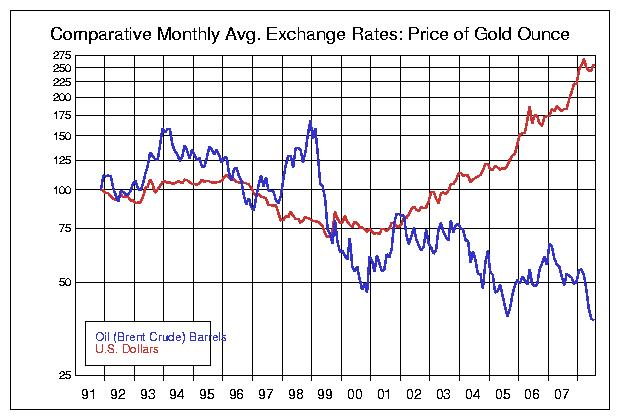
Graph © 2008 by Prof. Werner Antweiler, University of British Columbia, Vancouver BC, Canada. Used with permission. Time period shown in diagram: 1/Jan/1991 - 14/Jul/2008.

Looking at the graph another way, the red line reveals that an American today is having to spend almost 2.7 times the number of U.S. dollars he had to spend back in 1991 to buy a single ounce of gold (July 14, 2008 = 268). This is confirmed by comparing the USD prices of one ounce of gold in 1991 and today: $362 and $971, respectively.

Similarly, the blue line reveals that anyone today using an ounce of gold as currency can only buy 40% as much crude oil per ounce of gold as he could in 1991 (July 14, 2008 = 40). In other words, anyone must now use 2.5 times as much gold as he could in 1991 to buy one barrel of oil. This is confirmed by comparing the gold ounce prices of one barrel of oil in 1991 and today: 0.06 ounces of gold per barrel and 0.15 ounces of gold per barrel, respectively.

So, a barrel of oil has increased in price by 150% in terms of gold ounces since 1991 and, at the same time, an ounce of gold has increased in price by 168% in terms of 'goldless' U.S. dollars. Thus, gold solves the riddle: the price of crude oil is high and rising primarily due to the 'goldless' USD losing its purchasing power, and secondarily due to the strong global demand for oil. That is why the same single barrel of oil that cost only $23 in January 1991 costs over $140 in July 2008.

In short, as the U.S. dollar in his pocket becomes increasingly worthless, the average American is being forced to cough up more 'goldless' U.S. dollars to convince a seller of a barrel of oil to make a fair trade. Who can blame the oil seller if she believes "fair" requires ever more increasingly worthless U.S. dollars to complete the sale of an increasingly demanded barrel of oil?

The Ratings Agencies

Classification: UNCLASSIFIED

Voltron says: A fellow blogger (Mr. Liu) described the role of the
ratings agencies (Moody's, S&P and Fitch) along these lines: It's like
they watched an NC-17 orgy and rated it PG-13. All the teenagers loved
it and wanted to join the action. You can imagine the rude surprises
that awaited them.

Tuesday, July 8, 2008

Psst! Hear the Rumor of the Day?

Classification: UNCLASSIFIED

DealBook

By ANDREW ROSS SORKIN (New York Times)

“I will hurt the shorts, and that is my goal,” Richard S. Fuld Jr. fumed.

It was April, and Mr. Fuld was blaming short sellers, one of the most maligned tribes on Wall Street, for spreading rumors about Lehman Brothers, the troubled investment bank he runs. Shorts bet against stocks, and Lehman, they were whispering, looked like the next Bear Stearns.

Mr. Fuld must have been irate again last week, when Lehman’s stock price plunged 11 percent in the space of three hours for no apparent reason. The shares opened that June 30 morning at $22.25, drifted higher — and then took an abrupt turn around 1:30 p.m. Lehman closed that day at $19.81, its lowest level since 2000.

This time, the rumor du jour wasn’t that Lehman was going to be forced into bankruptcy. No, this time the talk was that Lehman was about to be sold to Barclays, the big British bank. It was eerily reminiscent of Bear Stearns’s fire sale to JPMorgan Chase in March. And when it comes to Lehman, the shorts have bet right lately: the stock has lost almost 70 percent of its value this year.

The rumor turned out to be wrong, as rumors often do. But this one even had an exact price: Lehman would be sold for $15 a share, traders buzzed all afternoon, in what would amount to a “take under” — Wall Street parlance for when a company sells itself for less than its market value.

Maybe a few people were whispering, but many more seemed to be listening. Talk that Barclays was buying even reached Lehman’s trading desks, where the rumor whipped around the office and then reverberated across Wall Street again. Panicky Lehman employees started calling friends outside the firm to find out what was going on inside the firm. One Lehman executive said, “Even my mother-in-law called me.”

Rumor-mongering, of course, has long been the stock in trade of some on Wall Street. Billions of dollars a day are bet on “whisper numbers” and overheard lunchtime chatter. Information is the coin of the realm. Some of it is legal. Some of it is not. Just ask Ivan Boesky.

But amid the desperation of a bear market — and the pervasion of technology that allows traders to communicate virtually untraceably — the art of the rumor has become increasingly powerful, even democratized. Absurd rumors can have legs, like the Lehman-Barclays one, which Richard Bove, an analyst at Ladenburg Thalmann, said “ranks up there with the moon is made out of green cheese in terms of its validity.”

Traders, outfitted with cellphones, regularly bypass their recorded, corporate phone lines — and compliance rules — to tip off friends at other firms, often by text messages. (By the way, let me debunk a popular myth: some phone companies save text messages, so you’re not free and clear.)

Instant-messaging has become another popular form of communication — and one that typically isn’t saved anywhere. Clever BlackBerry users send messages using PINs, bypassing their corporate servers. And then, of course, there’s e-mail, which as prosecutors have discovered remains a perennial favorite way to spread a rumor — catching the rumormongers in the act.

How else to explain the rapidity with which rumors circulate in the market these days? The telephone, long a rumormonger’s best friend, is inefficient next to a Bloomberg terminal.

Of course, the most dangerous rumors are the ones that aren’t true, especially the ones that send stocks south. That’s why shorts are being vilified as soulless profiteers.

An executive at Lehman said to me: “A rumor travels better than the truth. All you can do is deny, deny, deny. But it’s like being asked, ‘When did you stop beating your wife?’ ”

As an aside, David Einhorn, a hedge fund manager, has taken a lot of flak for being an outspoken short on Lehman. But that’s not to say he’s a rumormonger: he’s been open about his views, which have been both right and wrong.

In mid-June, Merrill Lynch may have been a victim of the rumor mill too. Its stock fell 3.6 percent as speculation flew that Merrill Lynch might announce big write-downs before announcing its earnings. Of course, that rumor proved false too. But is it just a coincidence that the rumor spread on a Friday known as a “quadruple witching day” — when lots of Merrill Lynch options were expiring?

Investors, or at least their lawyers, seem to be increasingly worried about the issue. In the last two months, a series of memos from law firms like Sullivan & Cromwell and Schulte Roth & Zabel have been sent out to banks and hedge funds. As Schulte Roth said in its note to clients, which include SAC Capital Management and Jana Partners, two big hedge funds, “spreading false rumors in order to induce others to trade in a company’s securities constitutes market manipulation.”

James Dimon, the chairman of JPMorgan, says rumor-mongering is unconscionable. “I think if someone knowingly starts a rumor or passes on a rumor, they should go to jail,” he said on Charlie Rose’s program on Monday night. “This is even worse than insider trading. This is deliberate and malicious destruction of value and people’s lives.”

Even the Securities and Exchange Commission chairman, Christopher Cox, seems to acknowledge the problem, though he hasn’t done much about it. In his letter to the Basel Committee after Bear Stearns was sold to JPMorgan, he said that “rumors spread about liquidity problems” and that Bear’s undoing “was the result of a lack of confidence, not a lack of capital.”

Confidence is vital to any business, but it is particularly important to financial companies. Bear Stearns, after all, was done in by what amounted to a run on the bank (which Bear, through its own mismanagement, was ill equipped to handle).

A spokesman for the S.E.C. said, “We definitely are vigorously pursuing rumors that are fraudulently manipulating markets.” He said that the commission is often working behind the scenes and has a “hedge fund working group” that is looking directly at the issue. He also pointed to a complaint against a hedge fund manager in April, who he said spread takeover rumors about Alliance Data Systems, as proof that the commission was doing its job.

Bryan Burrough, a co-author of “Barbarians at the Gate,” wrote an article for Vanity Fair this month in which he suggested an even more nefarious plot in which “a group of hedge fund managers actually celebrated Bear’s collapse at a breakfast that following Sunday morning and planned a similar assault on Lehman the next week.” That may be a bit too rich. (His article also blames the news media for fanning the flames at Bear.)

There’s no way to quantify whether rumors are more rampant today than they used to be or whether they are just traveling faster. But what is clear is that there seems to be little being done about it. It might be difficult to make a case, but you’d think you’d see subpoenas flying at least as fast as the rumor mill.


Monday, July 7, 2008

SEC Probe of Raters Uncovers `Significant Problems'

Classification: UNCLASSIFIED

By Jesse Westbrook and David Scheer

July 7 (Bloomberg) -- A U.S. Securities and Exchange Commission investigation into credit-rating companies found the firms improperly managed conflicts of interest and violated internal procedures in granting top rankings to mortgage bonds.

``The public will see that there have been significant problems,'' SEC Chairman Christopher Cox said in a Bloomberg Television interview today. ``There have been instances in which there were people both pitching the business, debating the fees and were involved in the analytical side.''

Pension and money-market funds bought AAA-rated securities backed by mortgages made to the riskiest borrowers because the instruments offered higher returns than government bonds with the same ratings. In many cases, credit raters were paid by the investment banks selling the bonds, prompting regulators and lawmakers to question their independence.

Credit raters were ``deluged with requests'' for ratings, leading to lapses, Cox said. ``The volume of work taxed the staffs in ways that caused them to cut corners, that caused them to deviate from their models.''

The SEC may release its findings as soon as this week, Cox said. The agency has been reviewing practices at firms such as Moody's Investors Service, Standard & Poor's and Fitch Ratings since September.

SEC spokesman John Nester declined to comment on whether any findings were referred to its enforcement division, which investigates and prosecutes wrongdoing. Examination reports don't typically describe findings at specific firms, he said.

Company Comments

S&P spokesman Edward Sweeney, Fitch spokesman David Weinfurter and Moody's spokesman Anthony Mirenda declined to comment.

Moody's said July 1 that an independent review found some employees violated internal rules when considering whether to downgrade debt securities whose ratings had previously been based on an error in its computer model. The inquiry found employees didn't change methodology to mask the error, it said. People involved may be subjected to disciplinary proceedings that include termination.

The SEC already has proposed a list of rules and other changes affecting credit ratings, including measures aimed at curbing conflicts of interest.

Last month, the agency acted to reduce investment firms' reliance on ratings by saying it may stop requiring money-market funds buy short-term debt carrying a high ranking. SEC commissioners also proposed rules that would bar credit raters from ranking a bond if they make recommendations to underwriters about how to gain a higher rating.

Ratings Rules

Additional rules under consideration include restricting gifts to credit-rating analysts from employees at investment banks and a requirement that companies label asset-backed securities using symbols different from the rankings placed on corporate and municipal debt.

A CFA Institute poll of almost 2,000 chartered financial analysts released today found that 11 percent said they saw a credit-rating company change its rating in response to pressure from an investor, issuer or underwriter. Fifty-five percent of respondents said credit-rating companies should be overseen by an independent regulator with enforcement


Friday, July 4, 2008

The Economy? Words Fail Me.

Classification: UNCLASSIFIED

By Dana Milbank (The Washington Post)

Think you're worried about the economy? Phillip Swagel is a wreck.

The assistant Treasury secretary for economic policy, Swagel came out for his monthly economic briefing yesterday, 90 minutes after the Labor Department reported that the country had shed jobs in June for the sixth straight month.

Does this mean the economy is worse than the Bush administration expected?

"We shouldn't, in a sense, be surprised when the data are, are, soft," Swagel managed to say.

Does the economy need another stimulus package?

"I-it seems, you know, it seems like that's, that's enough, uh, enough."

What might trigger another round of economic stimulus?

"I don't, I guess I don't have an answer, I mean, you know, beyond saying we look at all the data and, um -- so, my usual line."

Okay, so it wasn't a strong performance. But let's cut Swagel some slack. He's a sharp economist (his PhD is from Harvard) and, in ordinary conversation, he suffers none of the speech difficulties that plagued him on the stage yesterday. His various roles in government, at the Council of Economic Advisers, the Federal Reserve and the International Monetary Fund, were too junior for him to deserve any blame for the current economic troubles.

But Treasury Secretary Hank Paulson, who was in London yesterday, and Swagel's other superiors in the Bush administration left him with an impossible task: appearing on camera to put a favorable and reassuring gloss on an economy that has gone to the dogs.

Yesterday's report that 62,000 jobs were lost brought the total for the first half of the year to 438,000 jobs. Meanwhile, the Institute for Supply Management reported that its measure of the service sector had declined in June. Stock markets, flirting with a bear market, finished another losing week. Oil pushed to a record high. Inflation and foreclosures are up, consumer confidence is down, and administration forecasts for a "strong pace of growth" in the second half of 2008 are look increasingly absurd.

It was a hopeless spin assignment -- but Swagel, the administration's sacrificial lamb for the day, had to try. And so Swagel, bookish and bespectacled, entered the Treasury Department's briefing room with evident trepidation. He nodded and offered smiles every which way. His heavy breathing, picked up by the microphone, could be heard in the back of the room.

"Um, I'll start off as usual with a short statement and then, uh, take questions," he began.

In his statement, he employed the great euphemisms of his profession: the economic "headwinds," the housing "correction," the credit-market "disruption." But, he offered, "the stimulus package will help support . . . spending."

A questioner asked about private forecasts, which, in contrast to administration forecasts, see a contracting economy through early next year. "You know, it doesn't look like it to us now, but obviously we'll have to see where we are at the end of the year," he answered.

Might a second stimulus package be necessary? "Right now, the way we see it is the rebates that are already going out are big enough, and were timely enough, to make a difference and-and to support spending," he said.

Swagel was asked whether the energy shock and a longer-than-expected housing slump justify more federal action. He admitted that rising gas prices have pretty much offset the tax rebate checks, but this only proves, he said, that "the stimulus payments were timely and needed."

Asked if he could reassure those who worry it's time to hide valuables under the mattress and get a shotgun, he chuckled and then ventured: "You know it's i-in a sense what -- I think what matters is it's worse than, it's worse than, it should be."

For a brief, joyous moment for the economist, it appeared he had exhausted all the questions, but as soon as Swagel got out "I hope everyone has a good holiday," another hand went up.

The reporter asked if he saw any hope for economic revival in the new employment report. Swagel exhaled loudly. "No," he said, then sniffed and exhaled again. "You know, the data today, right, we had, wage gains were decent, but of course we know that overall inflation, uh, is going to fully offset and more those, uh, you know, those wage gains," he said. The unemployment rate remained at 5.5 percent, but "I don't . . . take any comfort from that."

Though still forecasting "modest but positive growth," he cautioned that "you're going to still see a weak labor market, so, um, yeah, so it's not, I don't expect to come out next month and, uh, you know, and have great news on the labor market, either."

And with that, the Treasury official departed the room for what one hopes will be some much-needed calm.


Das Monetary Policy

Classification: UNCLASSIFIED

By John Browne (EuroPacific Capital)


On June 25th, the Fed made no changes in its key interest rates and issued a statement that underscored how narrow their room for maneuver had become. Caught between the opposing forces of economic contraction and inflation, the Fed revealed that it was locked in neutral. Given that the Fed must use opposite remedies to satisfy the demands of its dual mandate (higher rates to curb inflation and lower rates to stimulate growth), the Fed is stuck firmly in neutral. There appears to be nothing left to do except to talk and hope for the best.

This inaction did not inspire confidence. The market sell-off in the days since the meeting has accelerated the swoon that has seen American stocks down by some 20 percent in the first six months of 2008. It is now official: the ‘bear’ market has begun.

Although leading policy makers do not dare to utter the name, the conditions currently confronting the Fed are known as “stagflation”. However, America is not the only major economy facing this grizzly beast. The European Union is also coming to grips with the problem. The difference in the manner that the America and Europe deal with the issue could make a huge impact on the world economy for years to come.

Unlike the American Fed, the European Central Bank (ECB) has only a single mandate; to curb inflation. Further, the ECB is based in Germany and is infused with a distinctly Germanic ethos. Although the bank president is in fact a Frenchman, Monsieur Jean-Claude Trichet, his policy moves firmly root him in the Teutonic financial tradition.

It is widely known that, since its terrible experiences with hyper-inflation after World War I, the Germans have developed an ingrained intolerance of inflation. As a result, the ECB has shown a backbone that is completely lacking among the invertebrates at the Federal Reserve. The resulting confidence has led many holders of U.S. dollars, including central banks, to diversify major parts of their vast holdings of U.S. dollar trade surpluses into the Euro.

In just eight short years, this vast transfer of money has made the relatively young Euro the second most important currency in the world. There are now more Euros in physical circulation than there are U.S. dollars. Also, the Euro has risen in price by some 64 percent since its launch in 2000, to $1.64. This is all the more extraordinary, when one considers that Europe does not have either a single economy or even a single government. As yet, it is still only an association of governments!

Of course, much of the credit for the astounding rise of the Euro must go to the massive debasement of the U.S. dollar, a debasement that has robbed every single man, woman and child who holds or invests in dollars.

The debasement of the U.S. dollar started way back in the 1970s, with the choice of inflation, over taxation and debt, as the means of financing the unpopular Vietnam War. It was enhanced by President Nixon’s breaking of the U.S. dollar/gold ‘exchange window’ in 1971. Since then, the American economy has tragically become transformed from that of a ‘producer’ base to one of a ‘consumer’ base.

Some may wonder why the holders of vast U.S. dollar reserves, such as central banks around the world, could tolerate this continued dilution of their dollar wealth. The answer, of course, was that there was no alternative. The American economy dominated the world and its dollar was ‘King’ largely because it was the undisputed ‘reserve’ currency. As a result, almost all internationally traded commodities were priced in U.S. dollars.

In addition, many nations, including OPEC countries and China, have decided to peg their currencies to the dollar. Finally, all international oil producers demanded payment in U.S. dollars. This meant that a Swiss buyer of oil had first to purchase U.S. dollars in order to buy oil.

The result was that the ‘reserve’ status provided a massive underpinning for the U.S. dollar and has long delayed its decline.

Today however, things have changed, dramatically. Many oil producers now demand Euros in payment for oil. Important nations have abandoned the dollar as a peg for their currencies. Worst of all, the debasement of the U.S. dollar is fast eroding faith in paper money. There is now rising, but so far hidden, pressure for a more reliable international ‘reserve’ currency.

The most obvious choice would be the Euro, especially after the expected European unification treaty of Lisbon is finally ratified in 2009. If it is, one can expect increasing pressure to have the Euro adopted as a replacement or as an alternative international reserve currency.

If the U.S. dollar loses or even has to share its ‘reserve’ status, it will become increasingly vulnerable to a panic run. The July 3rd meeting of the ECB is likely to prove crucial. If the Germanic view wins out and the ECB raises its rates, it risks both a run on the dollar and the possible loss of the dollar’s ‘reserve’ status.

If such a move were adopted, it would involve a further international risk; the pushing of a looming recession into a depression, just as it did in 1930, when the same anti-inflation sentiment prevailed.


Thursday, July 3, 2008

Fortune article on Lehman

Classification: UNCLASSIFIED

Paulson: We must improve tools to facilitate the "orderly failure of a large complex financial institution"

Classification: UNCLASSIFIED

From MISH'S Global Economic Trend Analysis:

The July 2nd Remarks of Treasury Secretary Henry Paulson, on the World Economy and Markets before the Chatham House were quite remarkable. Let's have a look at a few of them.

Whether it was Long Term Capital Management in 1998 or Bear Stearns this year, it is clear that Americans have come to expect the Federal Reserve to step in to avert events that pose unacceptable systemic risk. But, as we noted in our Blueprint, the Fed has neither the clear statutory authority nor the mandate to attempt to anticipate and prevent risks across our entire financial system.

We need to strengthen our practices and financial infrastructure in the OTC derivatives market and in the tri-party repo system. Important work is underway in each of these areas, and needs to be completed quickly.

To address the perception that some institutions are too big to fail, we must improve the tools at our disposal for facilitating the orderly failure of a large complex financial institution.

It is clear that some institutions, if they fail, can have a systemic impact, so we must give regulators the authorities to limit that impact and facilitate an orderly failure.

In my estimation this is tacit admission that large financial institutions are poised to fail, and the tools are not in place "to limit that impact and facilitate an orderly failure".

Saturday, June 28, 2008

Fed can't control inflation AND stimulate growth

Classification: UNCLASSIFIED

Voltron says: NPR explains why the Federal Reserve is between a rock and a hard place.

Bob Moon: The stock market tanked again today under the growing anxiety of ever-higher oil prices. Inflation is rising around the world. And critics say the Federal Reserve is standing by and letting it happen, with its lack of attention to the sinking dollar. Barclays Capital complained today that the Fed's credibility is "below zero."

So what can Ben Benanke and Company realistically do about the situation? Marketplace's Nancy Marshall Genzer has been asking some experts.


Nancy Marshall Genzer: It's been extra hot in Washington over the past few days. But the sweating at the Fed has nothing to do with the weather. The Fed is taking heat for the weakness of the dollar. That weakness has contributed to skyrocketing oil prices. Oil is priced in dollars. When the dollar drops, oil prices rise to compensate.

But John Hancock Financial Services economist Oscar Gonzales says there are other forces at work.

Oscar Gonzales: The price of oil is determining the market. It's a matter of supply and demand.

Nonetheless, oil broke above $142 a barrel today. And that has countries around the world pointing the finger at the Fed. Low U.S. interest rates are being blamed for creating global inflation. Of course, the Fed could raise interest rates to reverse this. Barclays Capital is predicting six interest rate increases by the end of next year.

Mark Gertler: That's just completely knuckleheaded.

Mark Gertler is an economist at New York University. He says the Fed won't act until real inflation problems start showing up in the U.S.

Gertler: But if you sort of calm down and look at the facts, we're feeling the effects of food and energy prices but that hasn't fed into core inflation or wage inflation.

But Moody's dot com chief economist Mark Zandi says if that changes, the Fed won't hesitate to raise rates.

Mark Zandi: If inflation broadly becomes unhinged, starts to rise, they have absolutely no choice. They have to sacrifice the near term economy.

Zandi says there's no way to wring inflation out of the economy, without causing some pain.

In Washington, I'm Nancy Marshall Genzer for Marketplace.


Manhattan Office Rents Fall, First Time in 3 Years

Classification: UNCLASSIFIED

Voltron says: one reason  why SRS is back above $100 . . .

By David M. Levitt and Daniel Taub

June 27 (Bloomberg) -- Manhattan office rents fell 2.2 percent in the second quarter to $69.29 a square foot annually, the first decline in the most expensive U.S. office market since 2005, according to real estate broker Studley Inc.

Average rents fell to $69.29 a square foot annually, and rents for Class A office space declined 4.4 percent, to an average $90.65 a foot, according to a preliminary report by Studley. The broker blamed a ``malaise'' among Wall Street securities firms, which hadn't previously stopped the rise in rents. The full report will be released next week.

``We're really starting to see the culmination of what people have been expecting to occur since the fourth quarter of last year,'' Steven Coutts, Studley's senior vice president for national research services, said in a telephone interview. ``It's the result of the whole chain of events, from the subprime to financial jobs being lost in the city. In some cases, it's starting to affect secondary industries. We're starting to see a slowdown in advertising and publishing.''

New York City's Independent Budget Office said in a report last month that it expects the city to lose 33,300 finance jobs, a decline of 7.1 percent from the peak in 2007. That would follow an industry loss of 52,500 jobs in New York during the 2000-to-2003 market drop.

More than 9,000 jobs are being eliminated at New York-based Bear Stearns Cos., acquired this month by JPMorgan Chase & Co. New York has lost 10,000 financial services jobs since last August, a 3.5 percent fall, according to the Bureau of Labor Statistics in Washington.

`Critical Catalyst'

An increase in space offered for sublease, which had been ``contained'' before mid-March, ``was the critical catalyst that moved the market in the second quarter,'' Studley said. Manhattan's office availability rate rose to 8.2 percent in the second quarter, up from 7.3 percent a year earlier and the highest since the third quarter of 2005.

Sublet space available for rent was at a low of 6.2 million square feet (576,000 square meters) in mid-January, surged to 7.8 million square feet in late March, and reached 8.3 million square feet by the middle of this month. While the amount of space for sublet jumped by almost a third since mid-January, the new space available still is less than a third of what Manhattan tenants typically lease each quarter, Studley said.

Subleases

A rising amount of space available for sublet can cut rental rates because landlords have to compete against tenants who would rather lease at a low price than lose money on empty space.

``A subletter will drop their price much more quickly than a landlord,'' said Ruth Colp-Haber, a partner at Wharton Property Advisors, a New York-based tenant representation firm. ``A landlord needs to keep their rents high to justify their financing, to justify their whole existence.''

The supply of ``big block'' space, or contiguous areas of 50,000 square feet or more, has almost doubled since its low a year ago, Studley said. The big-block supply rose to 7.6 million square feet from 4.5 million square feet in midtown Manhattan, and to 6.5 million square feet from 2.9 million square feet downtown.

Those numbers ``understate the range of space that is actually available for lease,'' because almost 3.5 million square feet of additional space that hasn't been being publicly marketed ``is rumored to be in play,'' Coutts wrote.

Large landlords such as SL Green Realty Corp. and Vornado Realty Trust are likely protected against rent declines because their occupancy rates tend to be higher than the market average, and their tenants are on long-term leases, Coutts said.

Drop in Values

Declining rents will reduce the value of their properties, he said. New York office buildings have already lost 20 to 30 percent of what they were worth last year, Green Street Advisors said in a May 25 report.

``Even though they're not feeling the pain as far as rent roll right now, ultimately the value of the properties are affected because of the fact that the expectations of increased rent upon lease rollover are absolutely coming down,'' Coutts said in the interview.

Shares of landlords with significant office holdings in Manhattan have declined this year. Boston Properties Inc. fell 1 percent through yesterday, Brookfield Properties Corp. is down 6 percent, SL Green declined 10 percent and Vornado dropped 0.3 percent.

Manhattan's office market may still feel further pain from additional job losses resulting from declines in the financial- services industry, he said.

``This downturn started in the financial sector, the heart of Manhattan's economy,'' Coutts wrote in the report. ``Professional and business firms have just begun to feel the chill of the loss in revenues in the financial sector and will likely start to contract in the coming quarters.''


Thursday, June 26, 2008

Shorting Stocks Could Be Way to Play This Market

Classification: UNCLASSIFIED

Voltron says: remember my theory about Joe-six-pack pumping money into short ETFs and trashing the market . . .


CNBC

With the Federal Reserve likely to keep interest rates on hold the rest of this year, many investment pros expect the dollar to remain weak, oil prices to keep rising—and stocks to head even lower.

"It's not going to be a fun summer," says David Rovelli, head of US equity trading for Boston-based Canaccord Adams. "There's low volume, the Fed's not going to do anything because of the election, there's no catalyst and we're just drifting in nowhere land."

The central bank announced Wednesday it was holding its key short-term rate at 2% and gave no hint that it might boost rates soon to ward off growing inflation.

As a result, the dollar is likely to remain lower against foreign currencies, which whets investor appetite for dollar-denominated commodities, specifically oil. Stocks, in turn, aren't expected to rally—even from their current low levels—until the Fed signals a change in interest-rate policy.

So with a moribund market ahead, some investors are changing their strategy: instead of trying to find individual stocks or sectors that might rise in a down market, they're taking advantage of the broader market's trend downwards.

That means shorting the market, or betting on stocks continuing to decline.

"The reality is things go up and things go down, and if we're going to be efficient in making money in the market consistently, we have to take advantage of both," says Ron Ianieri, head of Options University. "There is a time to be short and being short something that is dropping is just as profitable as being long something that is up."

For traditional stock trading, a short sale involves borrowing shares, selling them to a third party, then buying them back at a later date with the hope that they'll be cheaper. Though the rewards can be great, the risk is high.

EFT Plays Less Risky

But short playing has become much easier and less risky with the onslaught of ETFs, or exchange-traded funds, that have flooded the market over the past 10 years. ETFs work much the same way as mutual funds but offer greater trading flexibility and lower costs.

Kathy Boyle, president of Chapin Hill Advisors, has been using ETFs heavily to short the market recently and has realized 20 percent gains over the past few weeks. ProShares is a leader in not only long-play sector-based ETFs but also ones that short the market and offer double the return on downward index movements.

They include the ProShares Ultrashort QQQ (AMEX:QID - News), which rewards a fall in the Nasdaq; Proshares Ultrashort S&P 500 (AMEX:SDS - News), which rewards a fall in the S&P benchmark, and the Proshares Ultrashort Dow 30 (AMEX:DXD - News), which tracks the bluechip industrials.

Rydex recently rolled out eight new ETFs, half of which offer double-inverse plays on the energy, financial, health care and technology sectors. The Rydex Inverse 2x Select Sector Financial (AMEX:RFN - News) was up more than 8 percent in light Thursday trading.

Voltron says: If ETFs are going to cause a crash, you want to be ahead if it.  I.E. short.

Wednesday, June 25, 2008

Dow Chemical Raises Prices for Second Time in a Month

Classification: UNCLASSIFIED


Meanwhile, from the NY Times: Dow Chemical Raises Prices for Second Time in a Month


The Dow Chemical Company said Tuesday that it was raising prices for the second time in a month to offset a “relentless rise” in energy costs, a sign that companies may increasingly have to pass on price increases to their customers.

The increase of as much as 25 percent — the largest in the company’s history — comes after a 20 percent rise last month that the company said did not go far enough given the continuing surge in energy prices.


Andrew Liveris, chairman and CEO of Dow Chemical, June 24, 2008:


"Frankly, there's very few levers left ... [T]his energy crisis is affecting consumers ... People aren't spending. People aren't driving. Really, you need to look at ways to control what's happened in the inflationary world and really take the risk that by raising rates, you may actually cause some demand to go weaker. I think it's back to where Paul Volcker was in the early '80s. There's a real risk here and we've got stagflation. You can only break out of it one way and you better take on inflation head-on."


Thursday, June 19, 2008

RBS issues global stock and credit crash alert

By Ambrose Evans-Pritchard, International Business Editor, U.K. Telegraph

The Royal Bank of Scotland has advised clients to brace for a full-fledged crash in global stock and credit markets over the next three months as inflation paralyses the major central banks.

"A very nasty period is soon to be upon us - be prepared," said Bob Janjuah, the bank's credit strategist.

A report by the bank's research team warns that the S&P 500 index of Wall Street equities is likely to fall by more than 300 points to around 1050 by September as "all the chickens come home to roost" from the excesses of the global boom, with contagion spreading across Europe and emerging markets.

Such a slide on world bourses would amount to one of the worst bear markets over the last century.

·  RBS alert: Quotes from the report

·  Fund managers react to RBS alert

·  Support for the euro is in doubt

RBS said the iTraxx index of high-grade corporate bonds could soar to 130/150 while the "Crossover" index of lower grade corporate bonds could reach 650/700 in a renewed bout of panic on the debt markets.

"I do not think I can be much blunter. If you have to be in credit, focus on quality, short durations, non-cyclical defensive names.

"Cash is the key safe haven. This is about not losing your money, and not losing your job," said Mr Janjuah, who became a City star after his grim warnings last year about the credit crisis proved all too accurate.

RBS expects Wall Street to rally a little further into early July before short-lived momentum from America's fiscal boost begins to fizzle out, and the delayed effects of the oil spike inflict their damage.

"Globalisation was always going to risk putting G7 bankers into a dangerous corner at some point. We have got to that point," he said.

US Federal Reserve and the European Central Bank both face a Hobson's choice as workers start to lose their jobs in earnest and lenders cut off credit.

The authorities cannot respond with easy money because oil and food costs continue to push headline inflation to levels that are unsettling the markets. "The ugly spoiler is that we may need to see much lower global growth in order to get lower inflation," he said.

·  Morgan Stanley warns of catastrophe

·  More comment and analysis from the Telegraph

"The Fed is in panic mode. The massive credibility chasms down which the Fed and maybe even the ECB will plummet when they fail to hike rates in the face of higher inflation will combine to give us a big sell-off in risky assets," he said.

Kit Jukes, RBS's head of debt markets, said Europe would not be immune. "Economic weakness is spreading and the latest data on consumer demand and confidence are dire. The ECB is hell-bent on raising rates.

"The political fall-out could be substantial as finance ministers from the weaker economies rail at the ECB. Wider spreads between the German Bunds and peripheral markets seem assured," he said.

Ultimately, the bank expects the oil price spike to subside as the more powerful force of debt deflation takes hold next year.


Saturday, June 14, 2008

Lehman Execs Summoned for Weekend Meetings


By Charles Gasparino

Voltron says: The author is well known for spreading false rumors of bailouts and buyouts of mortgage insurer MBIA, which never panned out.  The takeaway, though, is that Lehman execs are scrambling this weekend much like Countrywide, New Century, and Accredited Home Lenders executives did before their companies imploded.

Senior executives at Lehman Brothers, the embattled Wall Street securities firm, have been summoned this weekend for a series of meetings as the firm prepares to release second-quarter earnings on Monday and speculation swirls that the firm may be sold to a larger bank, CNBC has learned.

Shares of Lehman have been hammered in recent weeks amid growing investor concern over the firm's balance sheet.

On Monday, Lehman preannounced a $2.8 billion loss and that it would raise $6 billion in new capital to bolster its balance sheet, which is bleeding losses because of soured loans on its books.

On Thursday, CNBC was first to report that Erin Callen, the firm's chief financial officer, and Joe Gregory, Lehman's president, were stepping down from their posts, only adding to investor concerns about Lehman's future.

Lehman Chief Executive Dick Fuld has been working overtime to restore investor confidence in the firm a after some investors believed they were misled about the size of the firm's losses and need for new capital. Because of the eroding investors support, and damage stemming from the firm's financial troubles, speculation is growing that the firm might have to be sold. CNBC reported that private equity firm Blackstone is interested in taking a stake in Lehman. Other firms have expressed interest in buying Lehman as well. Only after the reports of a possible sale, did shares of Lehman reverse a week-long slide.

The weekend meetings are unusual, say people close to the firm. The executives summoned to headquarters include everyone from Stephen Lessing, the head of Lehman private client group to Scott Freidheim, the firm's co-chief administrative officer. It is unclear if the meetings are related to a possible deal, or just preparation for the Monday's official earnings announcement, possibly the most important earnings release for Lehman in recent years.

A spokeswoman for Lehman had no comment. Contacted at his office on Saturday morning, Freidheim had no comment as well.

Wall Street executives say Lehman's current problems have taken a tremendous toll on CEO Fuld, known as the "gorilla" on Wall Street because of his tough management style that has saved Lehman from crisis in the past.

Fuld has resisted selling Lehman to bigger players in the past, and in doing, has built one of the most successful securities firm, which before the recent crisis was a darling of Wall Street.

However, many Wall Street executive believe the current fiscal crisis hitting Lehman is different that past troubles because of the size of the bad loans on the firm's balance sheet, and because Wall Street firms will likely face eroding profit margins for at least the next year.

Like most firms on Wall Street, Lehman has been cutting back on how much risk it will taking in trading and other businesses, in an attempt to prevent the firm from imploding as Bear Stearns did three months ago. While taking less risk may soothe investors concerns that the firm may lose even more money, it also means that Lehman will produce lower profits in the future.

The lower profit margins combined with the possibility of further writedowns of losses could force Fuld to sell the firm. At the very least, people close to Lehman expect Fuld to make some announcement about Lehman's future on Monday when it releases earnings.


Friday, June 13, 2008

Something big is happening

Voltron says: The graph below is the total amount of money that the Federal Reserve has had to lend banks in it's role as lender of last resort since 1920.


Voltron says: It's clear that something big is happening. What you are seeing in the nationalization of our financial system.

Thursday, June 12, 2008

LEH fires CFO and COO

Voltron says: Lehman fired their 3rd and 4th in command (basically the OpsO and AMO)


Lehman Brothers Holdings Inc. is replacing Chief Operating Officer Joseph Gregory and Chief Financial Officer Erin Callan as the brokerage deals with a tumbling stock price and questions about the firm's future.

Wednesday, June 11, 2008

Why SRS is down

Voltron says:  good explanation for why SRS is down.  See my comments in the middle and at the end.


IYR and SRS: When Opposites Attack

Adam Warner  Jun 11, 2008 1:45 pm


Inverse fund performance sometimes needs some explaining.


The more of these you look at these Inverses, the uglier it gets. Here's iShares Dow Jones US Real Estate (IYR), down about 5% over the past six months.


Click to enlarge


So how about the UltraShort Real Estate ProShares (SRS), the Double Inverse of this? It's up 10%, right? Well, not exactly. It's down 12%. I'm sure there were some dividends over this stretch, but that can't quite make up this shortfall.


Click to enlarge


David Merkel is not optimistic about the Triple Funds coming down the pike. I'm afraid to mention my "Duodecaphonic Inverse ETF," currently in the pipeline.

So what's going on? It could be bad management, but Woodshedder has a simpler explanation.

Let's say they're both $100. And then on Day 1 IYR rallies 1%. SRS will go down 2%, or $2 to $98. Then on Day 2, IYR dips back 1% to 99.99. SRS should then go up 2%, to $99.96. No one will really notice, but obviously this adds up.

On the flip side, an extended move in one direction will cause the combo to lift. Let's say IYR goes up 1% a day for five straight days. IYR is now 105.10, SRS is 90.39. You can even throw in some reversal days and get similar results.

Voltron says: SRS has 2x leverage, but IYR does not, so if you bought 2 shares of IYR (a bet that the index goes up) and 1 share of SRS (a bet that the index goes down)  In the previous scenario (up 1% for 5 days)  The two trades would not cancel out, you would actually make $0.59.  This is due to “negative convexity” or “non-linearity” of the SRS payout.


The bottom line though, is any round trip to "unch." will cause a loss in the combo over that particular time frame.

Why is this important? I mean, after all, it's essentially a directional bet, no?

Well, if nothing else, it implies an Inverse Fund is not likely your best alternative over the course of time, when compared with something like simply shorting the regular ETF, or using puts and/or calls.


Voltron says:  So if there is an extended move down in the real estate index, you’ll profit, but if the index whipsaws around (price volatility) you may take some lumps.  But compare the alternatives:  If you short, you have unlimited downside risk.  If you buy puts, you actually benefit from price volatility but you also have to get the timing right, which is difficult.  Given that and the convenience, in the long run I still think ETFs are like SRS a good tool.  SRS’s negative convexity isn’t a good thing, but it’s worth it to not have to worry about timing or unlimited risk.


Monday, June 9, 2008

Lehman Talks a Rosy Talk


The Wall Street Journal

HEARD ON THE STREET


Walking the Walk
May Prove Thornier
Than Bank Predicts
By DAVID REILLY

After raising $6 billion in fresh capital, Lehman Brothers Holdings Inc. quickly declared dead any questions about its ability to survive.

"The discussions at this point aren't about our viability or the fact that we will be here or the fact that we have sufficient liquidity," Chief Financial Officer Erin Callan said on a conference call with investors Monday. "I think we put that to bed on a number of different levels through our own actions."

Not so fast. Any firm that is forced to sell equity at a 20% discount to book value while diluting existing holders by 30% is far from out of the woods. And the recent track record of both Lehman and Ms. Callan means it will be some time before investors regain confidence in the firm.

[Combo]

Consider that earlier this year Lehman, amid falling mortgage markets, increased by about $2 billion its holdings of so-called Alt-A loans, or mortgages made to borrowers who aren't exactly prime. "We saw a great opportunity," Ms. Callan said March 18.

Now, less than three months later, that move doesn't look so smart. Lehman said Monday that it had gross write-downs of about $2 billion on residential-mortgage holdings, which are mostly Alt-A loans, during the fiscal second quarter that ended in May. That helped fuel what Lehman expects to be a $2.8 billion net loss for the quarter.

While Lehman may eventually see some of those holdings rebound, the episode underlines the big worry surrounding the firm: that it has been slower than peers in adequately marking down holdings and shedding deadweight assets.

Lehman may still face further losses on its still-big books of residential- and commercial-mortgage holdings. Those could cause the firm's reliance on borrowed money to again increase, even as they eat into its now-replenished capital base. Also, while Lehman in the past quarter trimmed its balance sheet by $130 billion, the firm had expanded the balance sheet by $95 billion in the previous quarter.

Lehman's defiant tone in the face of woeful performance also has jarred investors. Indeed, rather than sounding contrite about the firm's losses, Ms. Callan was quick to say it is ready to again play offense in markets.

True, the capital raising, along with the sale by Lehman during the quarter of about $130 billion in assets, is a step in the right direction. But the balance sheet is still wobbly.

And Lehman's most-vocal critic, David Einhorn, manager of hedge fund Greenlight Capital, who has been short the stock, betting it will decline, remains dissatisfied. "They just raised $6 billion of capital that they said they didn't need, to replace losses they said they didn't have."

Banks' Tries at Hedging Likely Will Show Losses

One criticism of Wall Street firms is that they are like hedge funds since their results are at the mercy of their trading strategies.

That viewpoint is likely to gain ground only as the brokerages report second-quarter earnings. The results at several investment banks are likely to contain big losses on trades made to protect their balance sheets against write-downs on risky assets.

Lehman Brothers, which gave investors an advance snapshot of its fiscal second-quarter earnings Monday, said these losses totaled $400 million on financial instruments that were bought to protect the bank against declines in the value of its commercial-mortgage assets.

The "hedging" losses increased the overall quarterly write-down on Lehman's commercial mortgages to $1.1 billion from $700 million. Analysts also expect hedging losses at Goldman Sachs Group Inc. and Morgan Stanley.

Since investment banks are supposed to have razor-sharp risk managers, how is it that they have been tripped up by their own hedges? In short, it appears they were all betting the same way.

Whenever a trade becomes popular, it becomes vulnerable to an adverse move because so many people try to exit it at the first sign of losses.

One of the most common trades on Wall Street has been to place a bearish bet on the CMBX index, which tracks the performance of credit-default swaps on bonds backed by commercial mortgages. In the second quarter, the CMBX moved against bearish trades. Making matters worse: Often the assets being hedged didn't post gains when the hedge lost value.

But it isn't all bad news. One investor thinks the bearish bets on the CMBX will work out. Carlos Mendez, managing director at asset manager ICP Capital, says the deterioration in the performance of bonds underlying the CMBX will move the index in a bearish direction -- and benefit the investment banks. But that assumes the banks haven't locked in the losses by then.